

Acupuncture vs Dry Needling for Back Pain: Key Differences, Effectiveness, and Safety
Compare acupuncture vs dry needling for back pain, including how each works, safety considerations, and which approach may provide longer-lasting relief

Back pain has a way of quietly reshaping your life.
You may still show up for work, exercise when you can, or push through weekend activities—but the pain always lingers in the background. Sometimes it improves for a while. Then it returns. Often in the same spot. Often without warning.
Back pain is one of the most common causes of missed work, limited mobility, and chronic discomfort, and many people search for non-surgical back pain treatment options when symptoms persist.
You have likely tried the usual at-home strategies—ice, heat, topical creams, massage, stretching, even ergonomic gadgets that promised relief but delivered little change. These approaches may reduce discomfort temporarily, yet the underlying problem remains unresolved.
At this stage, many people begin exploring needle-based therapies for back pain—most commonly acupuncture or dry needling. Both involve thin, solid needles. Both are used for musculoskeletal pain. And both are often discussed interchangeably.
But they are not the same treatment, and they do not work on the body in the same way.
Understanding the difference between acupuncture and dry needling for back pain is critical if your goal is not just short-term relief, but lasting resolution—especially when pain has become recurrent, chronic, or resistant to other therapies.
This article explains the difference between acupuncture and dry needling for back pain, including how each works, what conditions they treat best, safety considerations, and which approach may provide longer-lasting relief.
What Is the Difference Between Acupuncture and Dry Needling?
Acupuncture and dry needling both use thin needles, but they differ in training, treatment philosophy, and clinical scope. Acupuncture regulates the nervous system, inflammation, and circulation systemically, while dry needling focuses on releasing localized muscle trigger points.
What Is Dry Needling for Back Pain and How Does It Work?
Dry needling for back pain is a musculoskeletal technique used primarily by physical therapists and rehabilitation providers to reduce localized muscle tension. It involves inserting thin, solid filiform needles directly into hyperirritable areas of skeletal muscle—commonly referred to as trigger points—to decrease spasm and improve short-term mobility.
When used for back pain, dry needling typically targets the exact muscle where discomfort is felt, such as the lumbar paraspinals, quadratus lumborum, multifidus, or gluteal musculature. The intention is to disrupt abnormal neuromuscular firing patterns and temporarily reduce contraction within that specific tissue (1).
Dry needling treats back pain by targeting tight muscles directly, rather than regulating systemic pain drivers.
Needles are usually inserted briefly and manipulated to elicit a local twitch response before removal—often described as “flash needling.” Treatment sessions are focused narrowly on the painful region itself rather than on broader neurological or systemic contributors to pain.
How Does Dry Needling Relieve Back Pain?
Dry needling reduces back pain primarily through localized neuromuscular effects, including:
Disruption of dysfunctional motor end plates
Reduction in spontaneous electrical activity within trigger points
Short-term decrease in muscle spasm
Temporary improvement in localized blood flow
Brief modulation of nociceptive (pain) signaling
For acute muscle strain or clearly isolated tension patterns, this localized reset can produce noticeable relief (2).
However, chronic back pain is rarely caused by a single dysfunctional muscle. Muscle tension is often a downstream response to:
Autonomic nervous system overactivation
Ongoing inflammatory signaling
Postural compensation
Altered movement mechanics
Psychological or stress-related load
If these upstream drivers remain active, the same muscles frequently tighten again—sometimes within days.
→ Sports Medicine & Injury Rehabilitation
This is why many patients report that dry needling “helps, but doesn’t last.”
For isolated muscular strain, dry needling for lower back pain may provide short-term improvement. For recurrent or stress-responsive back pain, broader regulation is often necessary.
Does Dry Needling Provide Long-Term Relief for Chronic Back Pain?
Dry needling for chronic back pain may reduce localized muscle tension, but it does not directly address several common drivers of persistent or recurring back pain, including:
Nervous system sensitization and stress-related muscle guarding
Systemic or localized inflammatory processes
Fascial restrictions and altered movement patterns
Central pain amplification
Metabolic or immune-related contributors to chronic pain states
For this reason, dry needling often provides short-term relief rather than durable improvement in chronic low back pain. This pattern is especially common in recurrent lower back pain that flares under stress or prolonged sitting.
Because its scope is localized, dry needling is best understood as a targeted muscular intervention—not a comprehensive chronic back pain treatment that restores nervous system regulation, inflammatory balance, and coordinated recovery.
Temporary symptom reduction does not necessarily alter the underlying pain cycle (3).
This distinction becomes clinically important when comparing dry needling to acupuncture for back pain, particularly in chronic or stress-responsive cases.
When back pain is stress-responsive, inflammatory, or long-standing, isolated trigger point release may not be sufficient.
How Does Acupuncture Work for Back Pain?
While dry needling focuses on releasing a specific muscle, acupuncture for back pain treats pain as a regulatory disorder involving the nervous system, inflammation, circulation, and coordinated movement.
In clinical practice, persistent back pain is rarely caused by one tight muscle. It is more often the downstream expression of:
Autonomic nervous system imbalance
Ongoing inflammatory signaling
Impaired circulation
Compensatory movement patterns
Unresolved stress physiology
Acupuncture for chronic back pain is designed to address these upstream drivers. That is why its effects tend to extend beyond temporary muscle relaxation and support longer-lasting relief.
Why Acupuncture Addresses More Than Muscle Tension
Acupuncture uses precisely placed needles at specific acupuncture points that influence how the nervous system, immune system, and musculoskeletal system communicate.
Point selection is based on functional relationships — not simply proximity to where pain is felt.
When treating back pain, needles may be placed:
Locally near the spine or involved musculature
Distally in the hands, feet, or legs
Along pathways that regulate spinal segments and nerve roots
At points that reduce stress reactivity and pain amplification
Acupuncture for back pain works by influencing both local tissues and the central systems that regulate pain processing.
→ Acupuncture & Nervous System Regulation
Although some of these locations may appear unrelated to the back, they influence the neurological and vascular pathways that regulate muscle tone, inflammation, and pain perception (4).
This is the key distinction:
Pain is experienced locally — but it is regulated systemically.
How Acupuncture Reduces Inflammation and Nerve Sensitivity in Back Pain
Acupuncture supports back pain relief through coordinated physiological mechanisms rather than isolated tissue disruption.
Nervous system regulation
Acupuncture shifts the body out of sympathetic (“fight-or-flight”) dominance and into parasympathetic regulation. This reduces protective muscle guarding, lowers pain sensitivity, and decreases central amplification (5).
Inflammation modulation
Needling has been shown to influence pro-inflammatory cytokine activity while supporting tissue repair and recovery processes (6).
Improved microcirculation
Acupuncture enhances local blood flow and oxygen delivery to affected tissues, supporting healing rather than prolonged irritation.
Fascial and connective tissue regulation
By improving tissue glide and reducing restriction, acupuncture restores more coordinated movement patterns that protect the spine over time.
Rather than forcing a muscle to release, acupuncture retrains how the body responds to stress, load, and mechanical input. That shift is essential for durable improvement in back pain.
Is Acupuncture More Effective Than Dry Needling for Back Pain?
Because acupuncture addresses both local tissue irritation and systemic regulation, it is particularly effective when back pain:
Repeatedly returns after temporary relief
Worsens during stress or poor sleep
Involves stiffness with nerve irritation
Persists despite physical therapy, injections, or medication
This is particularly relevant in chronic low back pain that fluctuates with stress, sleep disruption, or prolonged sitting.
By calming autonomic overactivation and restoring coordinated signaling across muscles, joints, and connective tissue, acupuncture interrupts the repetitive pain–tension–inflammation cycle that sustains chronic back pain (7).
This is also why acupuncture does not require aggressive local needling to be effective. Local points may be used, but they are integrated into a broader regulatory strategy rather than serving as the sole intervention.
Is Acupuncture Safer Than Dry Needling for Back Pain?
When comparing acupuncture and dry needling for back pain, safety and practitioner training are not minor technical differences — they directly influence clinical precision, risk profile, and long-term outcomes.
The spine and surrounding structures contain critical nerves, blood vessels, pleura, and internal organs. Any invasive technique involving needles in the cervical, thoracic, or lumbar region requires advanced anatomical knowledge, refined technique, and sound clinical judgment.
Back pain treatment is not simply about inserting a needle into a tight muscle. It requires understanding what lies beneath that muscle and how the nervous system is responding.
Safe acupuncture for back pain depends on anatomical precision, systemic assessment, and proper licensure.
Training and Licensure Requirements for Acupuncturists
Licensed acupuncturists complete 3–4 years of full-time graduate education at accredited institutions. Training includes:
Advanced study of gross and regional anatomy
Physiology, pathology, and pain mechanisms
Safe needling depth, angle, and technique by anatomical region
Clinical diagnostics and individualized treatment planning
Hundreds to thousands of supervised clinical hours
Formal training in Clean Needle Technique and infection control
After graduation, acupuncturists must pass national board examinations and maintain licensure through ongoing continuing education.
This level of training prepares practitioners to safely treat complex back pain presentations, including:
Nerve irritation and radicular symptoms
Chronic inflammatory back pain
Postural and biomechanical compensation patterns
Stress-mediated muscle guarding
Acupuncture education includes comprehensive training in systemic pain regulation — not solely local tissue intervention (8).
Dry Needling Certification and Training Differences
Dry needling training is typically obtained through short post-graduate certification courses. These programs often range from several days to a few weekends and focus primarily on:
Identifying myofascial trigger points
Local muscle anatomy
Basic needle insertion techniques
Dry needling education does not generally include comprehensive training in systemic pain regulation, autonomic physiology, or full diagnostic frameworks. There is no standardized national board examination specific to dry needling, and credentialing requirements vary by state and profession.
While dry needling can be appropriate for isolated muscular dysfunction, limitations in training depth may become clinically significant when treating:
Deep thoracic musculature near the lungs
Lumbar regions adjacent to major vascular structures
Complex or chronic pain presentations
Why Training and Scope Matter in Back Pain Treatment
Back pain frequently involves overlapping contributors:
Disc irritation
Nerve compression
Central pain sensitization
Inflammatory signaling
Compensatory movement patterns
Effective and safe treatment requires the ability to:
Differentiate muscular pain from nerve-related pain
Adjust needling depth and angle based on anatomy
Modify treatment strategy as symptoms evolve
Avoid excessive tissue irritation in sensitized patients
The safety of acupuncture or dry needling for back pain depends heavily on anatomical depth awareness and clinical decision-making. Because needling is invasive, precision matters — especially near the spine and rib cage.
Acupuncture is structured as a comprehensive regulatory system rather than a purely mechanical intervention. Practitioners trained in full anatomical mapping, systemic physiology, and individualized diagnosis are better equipped to adapt treatment in real time and reduce risk.
When choosing acupuncture or dry needling for back pain, licensure, board certification, and depth of clinical training are central safety considerations — not peripheral details.
Acupuncture vs. Dry Needling for Back Pain: A Clear Clinical Distinction
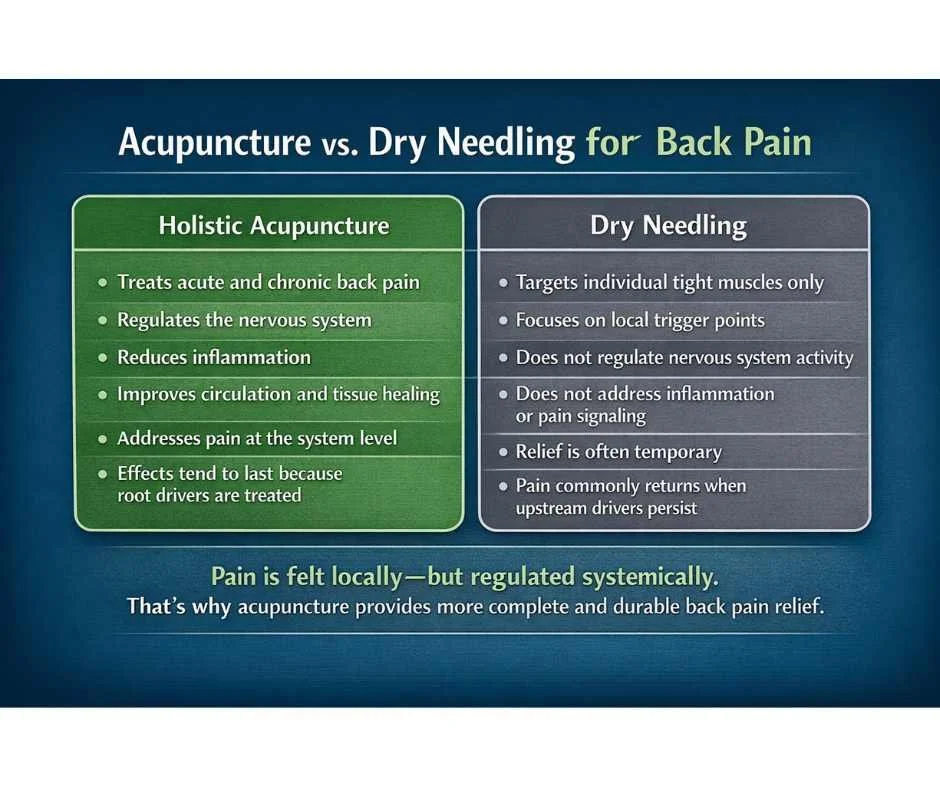
Although acupuncture and dry needling both use thin, solid needles, they are not equivalent treatments. The distinction matters — particularly when back pain is acute, recurrent, or long-standing.
When comparing acupuncture vs dry needling for back pain, the difference lies in scope, training, and how each therapy regulates pain.
Back pain is driven by more than muscle tension alone. Even sudden flare-ups involve a combination of:
Nervous system reactivity
Inflammatory signaling
Circulatory changes
Protective muscle guarding
Treating only the muscle where pain is felt does not address how pain is generated, amplified, or sustained within the body (1).
Acupuncture is designed to engage these systems simultaneously, which is why it remains effective for both acute and chronic back pain.
Key Differences Between Acupuncture and Dry Needling
Acupuncture approaches back pain as a system-level regulatory issue.
Treatment is designed to:
Calm excessive nervous system signaling
Reduce inflammatory activity
Improve circulation and tissue oxygenation
Restore coordinated muscle and fascial function
Needles may be placed locally near the spine and distally in areas that influence spinal segments, nerve pathways, and stress regulation. This allows acupuncture to address both immediate pain and the conditions that cause pain to persist or recur (2).
Dry needling, by contrast, is a localized trigger point technique. It focuses on releasing individual trigger points within tight muscles. While this may temporarily reduce tension, it does not directly regulate autonomic activity, modulate systemic inflammation, or correct broader compensation patterns contributing to back pain (3).
Why This Difference Matters for Chronic and Recurrent Back Pain
Pain is experienced locally — but regulated centrally and systemically.
When treatment targets only the site of discomfort, upstream drivers such as stress-mediated muscle guarding, inflammatory signaling, and altered pain processing often remain active. This reinforces the pain cycle.
Holistic acupuncture works at both levels. It can reduce pain intensity during acute flare-ups while restoring regulation across the nervous system and musculoskeletal system. That dual action supports longer-lasting improvement rather than repeated temporary relief (4).
Dry needling does not provide this level of systemic engagement. For those seeking durable improvement rather than episodic symptom suppression, this distinction becomes clinically significant.
Is Acupuncture More Effective Than Dry Needling for Back Pain?
For acute, recurrent, or chronic back pain, acupuncture offers broader therapeutic impact because it addresses:
Immediate tissue irritation
Nervous system sensitization
Inflammatory signaling
Circulatory support for healing
Coordinated muscle and fascial function
This is particularly relevant in chronic low back pain that returns after temporary relief from localized treatments.
By treating both the symptom and the regulatory systems generating it, acupuncture interrupts the recurring pain–tension–inflammation cycle that keeps back pain active.
What to Expect During Acupuncture for Back Pain
If you are considering acupuncture for back pain, understanding the process helps set realistic expectations — and clarifies how it differs from treatments focused solely on symptom suppression. Acupuncture for lower back pain and sciatica follows the same regulatory principles but is adapted to the specific pattern of symptoms.
Acupuncture is individualized. Each session is designed around your specific pain pattern, taking into account not only where discomfort is felt, but how nervous system regulation, posture, stress load, movement mechanics, and recovery capacity may be contributing.
Back pain is assessed as a pattern — not just a location.
Initial Assessment for Acupuncture for Back Pain
The first visit begins with a comprehensive intake and clinical evaluation.
In addition to reviewing the location and severity of back pain, assessment typically includes:
When and how symptoms began
Activities or positions that aggravate or relieve pain
Sleep quality and stress levels
Prior injuries, surgeries, or repetitive strain patterns
Whether pain radiates, stiffens, flares, or shifts over time
This information guides point selection and treatment strategy. Back pain that worsens under stress is approached differently than pain driven primarily by mechanical overload or prolonged sitting (1).
What Happens During an Acupuncture Session for Back Pain
During treatment, thin, sterile needles are placed at carefully selected acupuncture points.
Depending on the presentation, points may include:
Local points near the spine or involved musculature
Distal points in the hands, feet, or legs that influence spinal segments and nerve signaling
Points that calm sympathetic overactivation and reduce pain amplification
Needles are typically retained for 20–30 minutes.
Most patients describe sensations such as mild pressure, warmth, heaviness, or gentle spreading rather than sharp pain. A noticeable relaxation response is common as muscle guarding decreases and autonomic tone shifts.
Immediate and Short-Term Effects of Acupuncture for Back Pain
Common responses after acupuncture for back pain include:
Reduced pain intensity
Decreased stiffness
Improved mobility
A calmer, more regulated nervous system state
Some individuals experience improvement after the first session, particularly during acute flare-ups. Others notice gradual changes across several treatments as inflammation resolves and nervous system patterns recalibrate (2).
Temporary soreness or mild fatigue may occur, especially early in care. This typically reflects physiological adjustment rather than aggravation.
How Many Treatments Are Needed for Lasting Back Pain Relief?
Most patients with acute back pain notice improvement within a few sessions, while chronic or recurrent back pain typically requires a series of treatments for durable relief.
For recurrent or long-standing back pain, acupuncture is most effective when delivered as a short treatment series rather than a single visit.
Repeated sessions allow time to:
Interrupt recurring pain–tension–inflammation cycles
Restore coordinated muscle function
Improve circulation and tissue repair
Normalize central pain processing
As regulation improves, treatments are spaced farther apart. The goal is durable improvement that holds between visits — not repeated temporary relief. (3).
The number of sessions depends on symptom duration, severity, stress load, and how sensitized the nervous system has become.
Acupuncture as Part of a Comprehensive Back Pain Treatment Plan
Acupuncture is highly effective for both acute and chronic back pain, but outcomes are often enhanced when integrated into a broader systems-based strategy — particularly when pain is recurrent or activity-limiting.
Acupuncture for back pain treatment is most effective when it is integrated into a coordinated strategy that addresses both mechanical and regulatory contributors.
By reducing nervous system sensitization and improving regulatory stability, acupuncture creates conditions that allow other therapies to work more effectively.
Depending on clinical findings, treatment may be combined with:
Targeted therapeutic exercise and movement retraining
Manual therapies to improve fascial glide
Supportive or regenerative strategies when tissue healing is delayed
Lifestyle adjustments addressing sleep, stress load, and inflammatory burden
Rather than masking pain, acupuncture stabilizes the regulatory systems that govern healing — allowing the body to move, recover, and adapt more efficiently over time.
→ Functional & Integrative Medicine
When to Consider Acupuncture for Back Pain
When chronic or recurrent back pain persists despite rest, exercise, or conventional care, muscle strain alone is rarely the full explanation. Ongoing symptoms often reflect a combination of nervous system sensitization, inflammatory signaling, impaired circulation, and altered movement patterns that prevent full tissue recovery.
This is particularly relevant in chronic low back pain that fluctuates with stress, prolonged sitting, or sleep disruption. By regulating autonomic nervous system activity, improving microcirculation, and reducing central pain amplification, acupuncture supports both symptom relief and the physiological conditions required for healing.
This dual regulatory effect explains why acupuncture remains effective for:
Acute back pain flare-ups
Recurrent mechanical back pain
Stress-responsive back tension
Chronic or long-standing pain patterns
Treatment is individualized rather than protocol-driven. Care evolves based on how symptoms behave over time, what aggravates or relieves discomfort, and how the body responds to mechanical load and stress. This adaptability supports progressive recovery instead of repeating the same intervention regardless of response.
A non-pharmaceutical, systems-based approach may be appropriate when back pain fails to fully resolve or continues to recur. Acupuncture works with the body’s regulatory processes rather than overriding them, supporting durable improvement instead of temporary suppression.
You may request a free 15-minute consultation with Dr. Martina Sturm to review your health concerns and outline appropriate next steps within a root-cause, systems-based framework.
Frequently Asked Questions About Acupuncture vs. Dry Needling for Back Pain
Is acupuncture better than dry needling for back pain?
Acupuncture and dry needling serve different purposes. Dry needling targets tight muscles locally, while acupuncture regulates nervous system activity, inflammation, and circulation. For chronic or recurrent back pain, acupuncture often provides broader and longer-lasting relief because it addresses systemic pain drivers.
What is the main difference between acupuncture and dry needling?
The main difference is scope and training. Acupuncture is a comprehensive medical system that regulates pain through neurological and inflammatory pathways. Dry needling is a localized trigger point technique focused on releasing muscle tension.
Does dry needling provide long-term relief for chronic back pain?
Dry needling may reduce muscle tightness temporarily, but it does not directly regulate nervous system sensitization or systemic inflammation. For chronic low back pain, relief is often short-lived unless broader pain drivers are addressed.
How many acupuncture sessions are needed for lower back pain?
Acute lower back pain may improve within a few sessions. Chronic or recurrent back pain typically requires a short treatment series to stabilize inflammation, nervous system reactivity, and movement coordination. The exact number depends on symptom duration and severity.
Is acupuncture effective for sciatica and nerve-related back pain?
Acupuncture is commonly used for back pain involving nerve irritation, including sciatica. By reducing inflammation and calming nerve sensitivity, it may help decrease radiating discomfort and improve mobility.
Is acupuncture safe for back pain?
When performed by a licensed practitioner using sterile technique and proper anatomical training, acupuncture is considered a low-risk therapy for back pain.
Is dry needling safe near the spine?
Dry needling safety depends on practitioner training, anatomical knowledge, and technique. Because the spine contains critical nerves, blood vessels, and lung tissue in the thoracic region, advanced anatomical precision is essential.
Does acupuncture hurt?
Most patients describe acupuncture sensations as mild pressure, warmth, heaviness, or tingling rather than sharp pain. Many experience a relaxation response during treatment.
Can acupuncture provide long-term relief for chronic back pain?
Acupuncture may support longer-term improvement by reducing inflammation, calming nervous system overactivation, and restoring coordinated movement patterns. Results depend on underlying contributors and treatment consistency.
Still Have Questions?
If the topics above reflect ongoing symptoms or unanswered concerns, a brief conversation can help clarify whether a root-cause approach is appropriate.
Resources
Journal of Pain – Acupuncture for Chronic Low Back Pain: A Systematic Review and Meta-Analysis
Archives of Internal Medicine – Acupuncture for Chronic Low Back Pain: Individual Patient Data Meta-Analysis
Annals of Internal Medicine – Acupuncture for Low Back Pain: An Overview of Systematic Reviews
Pain – Neurophysiological Mechanisms of Acupuncture Analgesia
Journal of Alternative and Complementary Medicine – Effects of Acupuncture on Autonomic Nervous System Regulation
Spine – Acupuncture Versus Conventional Therapy for Chronic Low Back Pain
Cochrane Database of Systematic Reviews – Acupuncture for Low Back Pain
Neuroscience Letters – Central Nervous System Mechanisms Underlying Acupuncture Analgesia