

Hemp Seed Oil vs CBD Oil vs Full-Spectrum Hemp Oil: What’s the Difference?
A Clinical Comparison of Cannabinoid Content, THC Presence, and Endocannabinoid System Effects
Hemp-derived products are often grouped together under broad terms like hemp oil or CBD, yet these products differ significantly in composition, function, and clinical relevance. Full-spectrum hemp oil, CBD oil, and hemp seed oil are frequently used interchangeably in conversation and marketing—but they are not the same, and they do not act the same way in the body.
This confusion matters. Each product is sourced from a different part of the hemp plant, contains a distinct biochemical profile, and interacts with human physiology in different ways. Some are nutritional oils, others contain biologically active cannabinoids, and only certain formulations meaningfully interact with the body’s endocannabinoid system. Choosing the wrong product for a given goal can lead to ineffective results, unnecessary expense, or misplaced expectations.
From a clinical and functional medicine perspective, understanding these differences is essential. The question is not which hemp product is “better,” but which type is appropriate for a specific purpose—whether that goal is nutritional support, localized tissue care, or broader regulatory effects involving pain, inflammation, or nervous system balance.
This guide clearly explains the differences between full-spectrum hemp oil, CBD oil, and hemp seed oil, including how they are made, what they contain, how they work in the body, and when each may—or may not—be appropriate.
What Is the Difference Between Hemp Oil and CBD Oil?
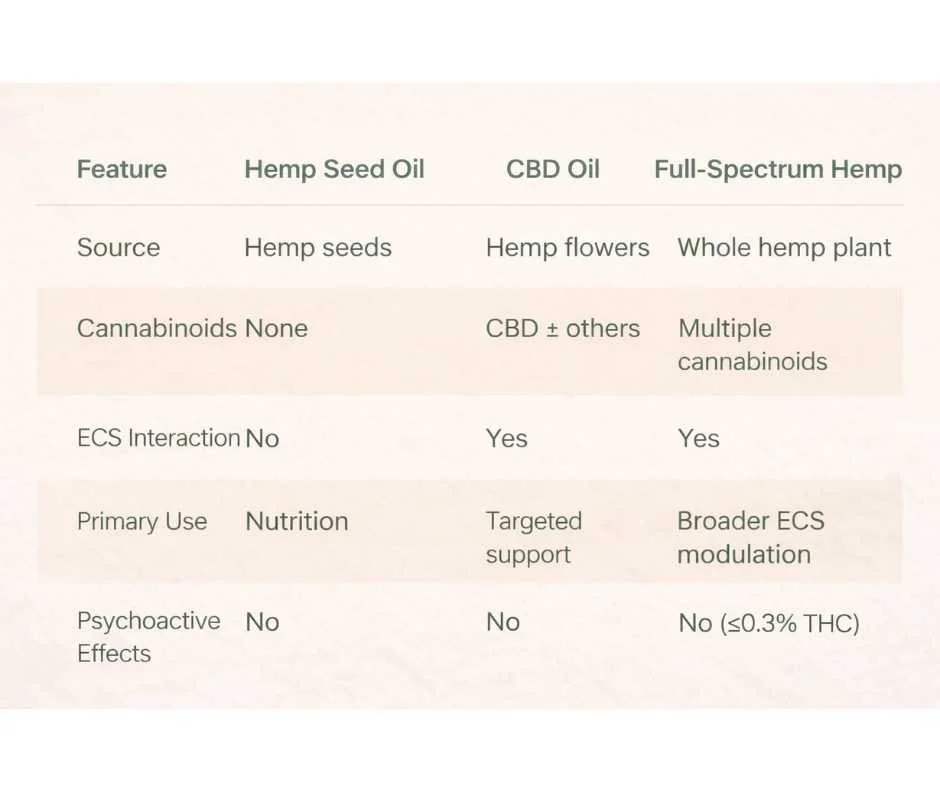
Hemp seed oil is a nutritional oil made from hemp seeds and contains no cannabinoids. CBD oil is extracted from hemp flowers and contains cannabidiol, a compound that interacts with the endocannabinoid system. Full-spectrum hemp oil contains CBD plus additional cannabinoids, including trace THC.
What Is the Endocannabinoid System (ECS)?
What Is the Endocannabinoid System and What Does It Do?
The human body contains an internal regulatory network known as the endocannabinoid system, which plays a central role in maintaining physiologic balance across multiple systems. Rather than targeting a single organ, this system helps modulate pain perception, inflammatory signaling, immune activity, stress response, mood, and sleep–wake regulation in response to internal and external conditions (1,2). Its function is adaptive and context-dependent, designed to fine-tune signaling rather than force the body in one direction.
The endocannabinoid system is composed of cannabinoid receptors, endocannabinoids produced by the body, and enzymes responsible for their synthesis and degradation (1). Together, these elements allow for short-lived, on-demand signaling that supports homeostasis and rapid adjustment to physiologic stressors (2,3).
What Is Anandamide (“The Bliss Molecule”) and How Does It Work?
One of the most extensively studied endocannabinoids is anandamide, often referred to as the “bliss molecule.” Anandamide primarily interacts with CB1 receptors in the nervous system and is involved in processes related to mood regulation, motivation, stress resilience, and emotional processing (4,5).
Unlike classical neurotransmitters that are stored and released in fixed quantities, anandamide is synthesized on demand and rapidly broken down after exerting its effects. This rapid degradation allows for flexible, transient regulation rather than persistent stimulation, helping the nervous system remain responsive rather than chronically activated (4,6).
How Hemp-Derived Cannabinoids Influence Endocannabinoid Signaling
This regulatory pattern is clinically relevant when discussing hemp-derived products. Plant cannabinoids do not replace anandamide or function as direct substitutes for endogenous signaling molecules. Instead, certain cannabinoids may influence endocannabinoid tone by interacting with cannabinoid receptors or by modulating the enzymes responsible for endocannabinoid breakdown, thereby indirectly affecting signaling balance (7,8).
Importantly, not all hemp-derived products interact with the endocannabinoid system. Hemp seed oil does not contain cannabinoids and therefore does not meaningfully influence anandamide signaling or cannabinoid receptor activity (9). Understanding this distinction is essential for accurately comparing hemp seed oil, CBD oil, and full-spectrum hemp oil, which differ substantially in composition and physiologic relevance.
→ Functional & Integrative Medicine
What Is Hemp Seed Oil and Does It Contain CBD?
What Is Hemp Seed Oil and How Is It Made?
Hemp seed oil is produced by cold-pressing the seeds of the hemp plant. From a nutritional standpoint, it functions similarly to other plant-based oils and is valued for its fatty acid profile—particularly its balance of omega-6 and omega-3 fatty acids—as well as vitamin E and other minor phytonutrients (10,11).
It has long been used as a culinary oil and topical moisturizer because of its emollient properties and ability to support skin barrier integrity.
Importantly, hemp seed oil is classified as a nutritional oil rather than a cannabinoid product. Its physiologic effects relate to lipid intake and skin hydration—not to nervous system or inflammatory signaling mediated by the endocannabinoid system (11).
Does Hemp Seed Oil Contain CBD or THC?
No. Hemp seed oil does not contain cannabinoids such as cannabidiol (CBD), tetrahydrocannabinol (THC), or other biologically active hemp compounds (12).
Cannabinoids are concentrated in the flowers and aerial portions of the hemp plant—not the seeds. As a result, hemp seed oil does not interact directly with cannabinoid receptors and does not influence anandamide signaling within the endocannabinoid system (12,13).
This distinction is often blurred in marketing. From a biochemical and clinical perspective, hemp seed oil does not engage cannabinoid pathways and should not be expected to influence pain signaling, stress response, mood, or sleep regulation through endocannabinoid mechanisms (13).
What Are the Benefits of Hemp Seed Oil for Skin and Nutrition?
Hemp seed oil may be appropriate when the goal is nutritional support rather than cannabinoid modulation.
Potential applications include:
Contributing essential fatty acids to the diet
Supporting skin hydration and barrier function
Providing plant-based lipid intake
Serving as a culinary oil in cold applications
Its benefits derive from its lipid profile—not from interaction with cannabinoid receptors (10,11).
When Is Hemp Seed Oil the Right Choice?
Hemp seed oil is the right choice when the goal is dietary fatty acid support or topical skin nourishment—not when cannabinoid effects are desired.
It may be appropriate when:
Cannabinoids are intentionally avoided
The objective is omega fatty acid intake
The use case is culinary or cosmetic
Endocannabinoid modulation is not required
When the therapeutic goal involves modulation of pain, inflammation, stress response, or nervous system regulation, hemp seed oil does not serve that role.
Recognizing this distinction prevents confusion and allows for more intentional product selection before comparing hemp seed oil with CBD oil or full-spectrum hemp oil, which differ fundamentally in composition and physiologic relevance.
What Is CBD Oil? Isolate vs Broad-Spectrum vs Full-Spectrum Explained
What Is CBD Oil and Where Does It Come From?
CBD oil is derived from the flowers and aerial parts of the hemp plant, which are the primary sites of cannabinoid production. Unlike hemp seed oil, CBD oil contains biologically active compounds that interact with the endocannabinoid system, most notably cannabidiol (CBD) (14,15). These products are formulated to deliver cannabinoids systemically or locally, depending on concentration and method of use.
CBD itself is non-intoxicating and does not produce the psychoactive effects associated with tetrahydrocannabinol (THC). Its physiologic relevance lies in how it modulates signaling pathways related to inflammation, stress response, pain perception, and nervous system regulation rather than acting as a direct stimulant or depressant (15,16).
CBD Isolate vs Broad-Spectrum vs Full-Spectrum: What’s the Difference?
CBD oil is available in several formulations that differ in cannabinoid composition and processing. CBD isolate products contain purified cannabidiol only, with all other cannabinoids and plant compounds removed. These formulations allow for precise dosing and are sometimes preferred for individuals who are sensitive to THC or who require strict avoidance of trace amounts (16).
Broad-spectrum CBD products contain cannabidiol along with other cannabinoids and plant compounds, but with THC removed during processing. Full-spectrum CBD products retain multiple cannabinoids, including trace amounts of THC within legal limits, as well as terpenes and other phytochemicals naturally present in the hemp plant (14,17).
From a clinical perspective, no single formulation is universally superior. Differences in response are influenced by individual physiology, dose, delivery method, and therapeutic context rather than cannabinoid complexity alone (17).
How CBD Interacts With the Endocannabinoid System
CBD does not bind strongly to cannabinoid receptors in the same way as THC or anandamide. Instead, it influences the endocannabinoid system indirectly by modulating receptor activity, signaling pathways, and enzymes involved in endocannabinoid metabolism (18,19). Through these mechanisms, CBD may affect how the body regulates inflammatory signaling, stress response, and nervous system activity.
Oral vs Topical CBD Oil: Differences in Absorption and Effect
The effects of CBD oil also depend heavily on formulation and delivery. Oral products are absorbed systemically and may influence widespread physiologic processes, while topical applications primarily act at the site of application with minimal systemic absorption (19). Variability in bioavailability and metabolism helps explain why individuals can have very different responses to seemingly similar CBD products.
Understanding these distinctions is essential before comparing CBD oil to full-spectrum hemp oil, which contains additional cannabinoids that may alter receptor interactions and physiologic effects.
What Is Full-Spectrum Hemp Oil and Does It Contain THC?
What Does Full-Spectrum Hemp Oil Contain?
Full-spectrum hemp oil is produced from the flowering portions of the hemp plant and contains a range of naturally occurring cannabinoids rather than cannabidiol (CBD) alone. In addition to CBD, these products may include cannabinoids such as cannabigerol (CBG), cannabichromene (CBC), and trace amounts of tetrahydrocannabinol (THC) within legally permitted limits, along with terpenes and other phytochemicals present in the original plant material (14,20).
Because these compounds are retained together, full-spectrum hemp oil reflects a broader biochemical profile than CBD isolate or some broad-spectrum products. This increased complexity can alter how the product interacts with cannabinoid receptors and related signaling pathways. The clinical relevance of this difference varies depending on dose, formulation, and individual physiology (17,21).
Does Full-Spectrum Hemp Oil Contain THC?
Yes. By definition, full-spectrum hemp oil contains trace amounts of THC within federally legal limits (≤0.3% THC by dry weight in the United States). These amounts are not intended to produce intoxicating effects, but sensitivity varies.
Even low concentrations may matter for:
Individuals highly sensitive to THC
Those undergoing drug testing
Individuals with certain psychiatric vulnerabilities
Patients taking medications that interact with cannabinoid pathways
For this reason, product testing, third-party verification, and clear labeling are essential when selecting a full-spectrum formulation.
Full-Spectrum Hemp Oil vs CBD Isolate: Key Differences
CBD isolate delivers a single purified cannabinoid—cannabidiol—without additional cannabinoids, terpenes, or THC. Full-spectrum hemp oil, in contrast, introduces multiple cannabinoids simultaneously.
These compounds may interact with different receptors and signaling pathways, creating distinct physiologic effects compared to isolated CBD (21). However, broader cannabinoid exposure does not automatically mean superior outcomes.
Some individuals respond better to simplified formulations, particularly when THC sensitivity is a concern. Others may tolerate—or prefer—the broader cannabinoid profile. Clinical response is individualized and context-dependent (17,22).
When Might Full-Spectrum Hemp Oil Be Appropriate?
Full-spectrum hemp oil may be considered when broader endocannabinoid system interaction is desired and trace THC exposure is not a concern.
It may be appropriate when:
A multi-cannabinoid profile is preferred
Prior response to CBD isolate was limited
There is no contraindication to trace THC exposure
Product quality and testing standards are verified
At the same time, cannabinoid selection should be evaluated within a broader health context—including nervous system regulation, inflammatory load, medication use, and overall treatment strategy.
Understanding how full-spectrum hemp oil differs from CBD oil and hemp seed oil provides a clearer framework for determining whether a multi-cannabinoid formulation is appropriate for a specific therapeutic goal.
Hemp Seed Oil vs CBD Oil vs Full-Spectrum Hemp Oil: How to Choose
Choosing between hemp seed oil, CBD oil, and full-spectrum hemp oil is not about determining which product is “best.” It is about selecting the formulation that matches a specific physiologic goal.
These products differ fundamentally in composition and mechanism. Selecting the wrong one often leads to unrealistic expectations, ineffective use, or unnecessary expense rather than meaningful benefit.
When to Choose Hemp Seed Oil for Nutrition or Skin Support
Hemp seed oil is appropriate when the goal is nutritional support rather than endocannabinoid modulation.
It may be considered when:
Increasing dietary omega-6 and omega-3 fatty acid intake
Supporting skin hydration and barrier integrity
Using a plant-based culinary oil
Avoiding cannabinoids entirely
Its value lies in its fatty acid profile—not in interaction with cannabinoid receptors or anandamide signaling. It should not be selected when the goal involves nervous system regulation, inflammatory signaling, or stress modulation.
When to Choose CBD Oil for Targeted Cannabinoid Support
CBD oil becomes relevant when the therapeutic goal involves interaction with regulatory systems such as:
Pain perception
Inflammatory signaling
Stress response
Nervous system balance
CBD provides targeted cannabinoid exposure and may be preferred when:
Precise dosing is important
THC avoidance is required
A simplified formulation is desired
Formulation and delivery method significantly influence absorption and consistency of effect (18,19). Oral, sublingual, and topical applications produce different pharmacokinetic profiles, which affects how CBD interacts with the body.
When Full-Spectrum Hemp Oil May Be Considered
Full-spectrum hemp oil introduces additional cannabinoids beyond CBD, including trace THC within legal limits. This broader biochemical profile may alter how the endocannabinoid system responds (21,22).
However, increased complexity does not automatically produce better outcomes.
Full-spectrum formulations may be considered when:
Broader cannabinoid exposure is desired
There is no contraindication to trace THC
Prior response to CBD isolate was limited
Product testing and labeling are verified
Individual sensitivity, medication use, and overall health context significantly influence appropriateness.
Why Cannabinoid Products Are Not Interchangeable
Hemp seed oil, CBD oil, and full-spectrum hemp oil are not interchangeable tools. Each serves a different physiologic purpose.
Appropriate selection requires evaluating:
Nervous system state
Inflammatory load
Metabolic stability
Sleep quality
Existing medications or therapies
Without this broader context, product use often becomes trial-and-error rather than intentional and clinically informed.
Making an Informed, Goal-Based Decision
Understanding what each hemp-derived product contains—and how it interacts with the body—allows for realistic expectations and more precise decision-making.
Hemp seed oil supports nutrition.
CBD oil provides targeted cannabinoid modulation.
Full-spectrum hemp oil delivers broader cannabinoid exposure.
Choosing intentionally reduces misuse and clarifies when a hemp-derived product is unlikely to address the underlying concern.
Hemp Seed Oil vs CBD Oil vs Full-Spectrum Hemp Oil — Quick Comparison
Hemp seed oil is made from hemp seeds and contains no cannabinoids. CBD oil is extracted from hemp flowers and delivers cannabidiol for targeted endocannabinoid modulation. Full-spectrum hemp oil contains CBD plus additional cannabinoids, including trace THC within legal limits. These differences determine whether a product provides nutritional support or cannabinoid signaling effects.
How to Use Hemp-Derived Products More Intentionally
Hemp seed oil, CBD oil, and full-spectrum hemp oil are often discussed as if they are interchangeable, yet they differ substantially in composition and physiologic relevance. Understanding whether a product contains cannabinoids—and whether those cannabinoids meaningfully interact with the endocannabinoid system—helps set realistic expectations and prevents misuse.
Hemp-derived products may be supportive in certain contexts, but they are not universal solutions. Their appropriateness depends on the specific goal, individual sensitivity, existing health conditions, and how they are integrated within a broader, systems-based approach. Without this context, even high-quality products may be ineffective or misapplied.
Clear distinctions between nutritional oils and cannabinoid-containing products allow for more informed, intentional decisions rather than trial-and-error use driven by marketing claims.
Personalized Guidance for Hemp and CBD Use
If you are considering hemp or CBD products for pain, inflammation, sleep concerns, stress regulation, or nervous system support, individualized guidance can help determine whether these tools are appropriate and how they may fit within a comprehensive care plan.
Frequently Asked Questions About Hemp, CBD, and Hemp Seed Oil
Is hemp seed oil the same as CBD oil?
No. Hemp seed oil is a nutritional oil made from hemp seeds and does not contain cannabinoids. CBD oil is made from the flowering parts of the hemp plant and contains cannabidiol, which interacts with the endocannabinoid system. Despite similar names, they serve very different purposes in the body.
Does hemp seed oil affect the endocannabinoid system?
No. Hemp seed oil does not contain cannabinoids and does not interact with cannabinoid receptors or endocannabinoid signaling. Its effects are related to dietary fats and skin hydration rather than nervous system or inflammatory regulation.
What is the difference between CBD oil and full-spectrum hemp oil?
CBD oil focuses primarily on delivering cannabidiol, either alone or alongside selected cannabinoids depending on the formulation. Full-spectrum hemp oil contains multiple cannabinoids, including CBD and trace amounts of THC, as well as other plant compounds. These differences can affect how the products interact with the endocannabinoid system, but neither is universally better for all situations.
Will full-spectrum hemp oil make me feel high?
Full-spectrum hemp oil contains only trace amounts of THC within legal limits and is not intended to produce intoxicating effects. Most people do not experience a “high,” although sensitivity varies. Individuals who are highly sensitive to THC may prefer CBD isolate or broad-spectrum products.
Why do some people feel benefits from CBD while others do not?
Responses to CBD vary due to differences in absorption, formulation, dose, nervous system state, metabolism, and overall health context. Using an inappropriate product type or delivery method is a common reason people report little or no effect.
Are hemp-derived products safe to use with medications?
CBD can influence liver enzymes involved in drug metabolism, which may affect how certain medications are processed. Anyone taking prescription medications should seek medical guidance before using oral cannabinoid products.
Are hemp and CBD products meant to treat medical conditions?
Hemp-derived products are not a replacement for medical care. They may be used as supportive tools in some cases, but their role depends on individual health needs and should be considered within a broader, systems-based approach rather than as standalone treatments.
Still Have Questions?
If the topics above reflect ongoing symptoms or unanswered concerns, a brief conversation can help clarify whether a root-cause approach is appropriate.
Resources
Nature Reviews Neuroscience – An introduction to the endogenous cannabinoid system
Trends in Pharmacological Sciences – Endocannabinoid signaling in pain and inflammation
Physiological Reviews – The endocannabinoid system as a regulator of homeostasis
British Journal of Pharmacology – Anandamide: synthesis, degradation, and physiologic role
Neuropsychopharmacology – CB1 receptor signaling and emotional regulation
Journal of Neurochemistry – Fatty acid amide hydrolase and anandamide metabolism
Frontiers in Pharmacology – Phytocannabinoids and endocannabinoid tone
British Journal of Pharmacology – Cannabinoid modulation of endocannabinoid enzymes
Food Chemistry – Absence of cannabinoids in hemp seed oil
Journal of Agricultural and Food Chemistry – Nutritional composition of hemp seed oil
International Journal of Molecular Sciences – Fatty acid profile and skin barrier effects of hemp seed oil
Cannabis and Cannabinoid Research – Distribution of cannabinoids in hemp plant anatomy
Annual Review of Pharmacology and Toxicology – Cannabinoid receptors and physiologic relevance
British Journal of Clinical Pharmacology – Cannabidiol pharmacology and mechanisms of action
Journal of Clinical Pharmacology – Clinical pharmacokinetics of cannabidiol
Frontiers in Pharmacology – CBD isolate versus full-spectrum formulations
Frontiers in Neuroscience – Cannabinoid interactions within the nervous system
European Journal of Clinical Pharmacology – Bioavailability of oral and topical cannabidiol
Drug Metabolism Reviews – Cannabidiol metabolism and drug interaction considerations
Journal of Natural Products – Phytochemical complexity of full-spectrum hemp extracts
Pharmacology & Therapeutics – Entourage effect: evidence and limitations
Current Neuropharmacology – Safety and tolerability of hemp-derived cannabinoids