

Microneedling for Menopausal Skin: Collagen Loss, Skin Thinning, and Facial Aging
How Declining Estrogen Affects Collagen, Dermal Thickness, Hydration, and Repair—and Where Microneedling Fits in Postmenopausal Skin Rejuvenation
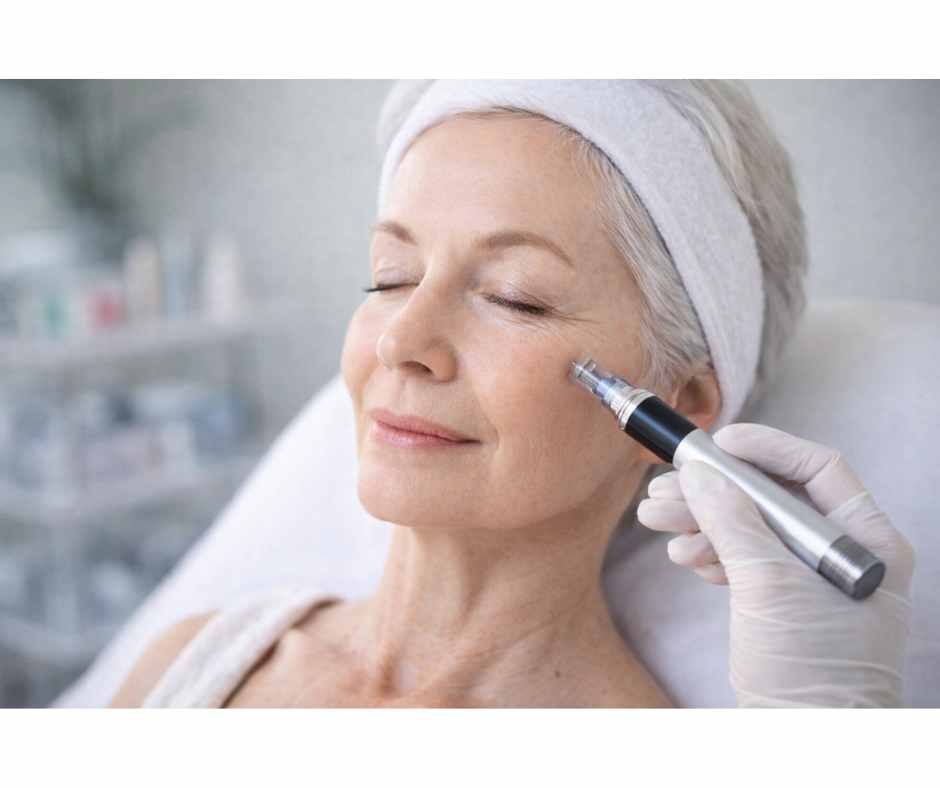
Skin can change noticeably during the menopausal transition. Estrogen receptors are present throughout the skin, and declining estrogen affects fibroblast activity, collagen turnover, dermal thickness, hydration, elasticity, and wound repair. Skin often becomes drier and thinner. Fine lines become more visible, and loss of firmness may show first around the eyes, lower face, jawline, and neck (1,2).
Estrogen decline is only part of the picture. Years of UV exposure and normal age-related collagen loss continue at the same time, while smoking, metabolic dysfunction, inadequate nutrition, inflammation, and impaired healing can accelerate the changes further (1,2). Two women at the same age and stage of menopause can therefore have very different skin.
Microneedling targets the collagen-remodeling side of this process. The controlled micro-injury initiates a wound-healing response that activates fibroblasts and remodeling of the extracellular matrix, including new collagen formation (3,4).
It cannot restore estrogen signaling or correct significant volume loss and tissue descent. What it can do is stimulate skin that is producing and remodeling collagen less efficiently than it did earlier in life. That distinction matters when deciding what microneedling can realistically accomplish after menopause.
→ Microneedling & Skin Rejuvenation
Does Microneedling Work After Menopause?
Yes. Microneedling can improve skin texture, fine lines, and mild loss of firmness after menopause by stimulating fibroblast activity and collagen remodeling (3,4). Menopause does not eliminate the skin’s ability to produce new collagen, but declining estrogen changes the dermal environment, affecting skin thickness, hydration, elasticity, and healing (1,2).
The degree of improvement depends on what is actually causing the visible change. Microneedling can stimulate local collagen remodeling, but it cannot replace estrogen, restore significant facial volume, or correct substantial tissue descent. Thin, photodamaged, reactive, or slower-healing skin also requires different treatment considerations than thicker, more resilient skin.
Why Skin Changes After Menopause
Estrogen’s Role in Skin Structure
Skin is an estrogen-responsive tissue. Estrogen receptors are present in keratinocytes, fibroblasts, sebaceous glands, hair follicles, and cutaneous blood vessels, which helps explain why declining estrogen affects both skin structure and function (1,2).
Within the dermis, estrogen influences fibroblast activity and extracellular-matrix turnover. It helps regulate:
Collagen synthesis and remodeling
Elastin organization
Dermal thickness
Hyaluronic acid and skin hydration
Barrier function
Wound repair
These are the same processes that determine whether skin remains thick, hydrated, elastic, and able to recover efficiently from irritation and injury (1,2).
What Declining Estrogen Means for Skin
As ovarian estrogen declines through the menopausal transition, fibroblast activity and collagen remodeling also change. Dermal collagen content decreases, the skin becomes thinner and drier, and wound repair can slow (1,2,5).
Common changes include:
Thinner, drier skin
Reduced elasticity and firmness
More visible fine lines and crepey texture
Greater skin fragility
Slower recovery after irritation or injury
Not every woman develops these changes to the same degree. Chronological aging, cumulative UV exposure, smoking history, metabolic health, nutrition, inflammation, and other factors continue to influence collagen breakdown and tissue repair at the same time (1,2).
Topical products can improve hydration, barrier function, and surface texture, but they do not produce the same type of dermal remodeling as procedures that intentionally stimulate a wound-healing response. Microneedling is one way to create that local collagen-remodeling stimulus (3,4).
How Microneedling Is Adapted for Postmenopausal Skin
Postmenopausal skin remains highly responsive to collagen induction. The key is not treating every woman the same way. Estrogen loss, cumulative UV exposure, dermal thickness, hydration, pigment tendency, and healing history all influence how the skin is treated and how the procedure is tailored (1,2,5).
An experienced practitioner adjusts depth, treatment intensity, pass pattern, treatment area, and recovery time according to the tissue in front of them. Thinner or more reactive skin may call for a more measured approach, while thicker or more resilient skin may tolerate a stronger stimulus. The goal is always the same: create enough controlled injury to activate fibroblasts and collagen remodeling without exceeding what the tissue needs (3,4).
Skin tone and pigment history are also part of treatment planning. Microneedling is used across a wide range of Fitzpatrick skin types and has a favorable safety profile when technique and post-treatment care are appropriate (6). A history of hyperpigmentation, sun exposure, or inflammatory skin conditions does not automatically rule out treatment; it simply informs how the procedure is performed.
There is no single “menopause protocol” because postmenopausal skin is not uniform. Good outcomes come from matching the treatment to skin thickness, photoaging, pigment characteristics, the area being treated, and the individual healing response.
How Microneedling Stimulates Collagen Remodeling After Menopause
Microneedling creates controlled microscopic injury in the skin and activates the normal wound-healing response. Fibroblasts become more active, growth-factor signaling increases, and the extracellular matrix begins to remodel, including new collagen formation (3,4).
This is more than a theoretical mechanism. Human biopsy studies after serial microneedling have documented increases in newly synthesized collagen as well as collagen types I, III, and VII (7). The remodeling continues well after the initial redness and inflammation have resolved, which helps explain why changes in texture and firmness develop gradually rather than immediately.
After menopause, that local response becomes especially relevant because baseline collagen turnover and dermal structure have already shifted with declining estrogen (1,2). Microneedling does not restore estrogen signaling. It gives the skin a mechanical stimulus to initiate repair and collagen production despite the age- and hormone-related decline in baseline remodeling.
The best results are seen when the treatment target matches what microneedling can actually change. Fine lines, uneven texture, crepey skin, and mild loss of firmness are more appropriate targets than substantial facial volume loss or pronounced tissue descent (3).
→ Microneedling in Denver: Benefits, Safety, and Skin Regeneration
GHK-Cu, Copper Peptides, and Skin Repair
GHK-Cu is a naturally occurring copper-binding peptide involved in tissue repair and extracellular-matrix remodeling. Laboratory and preclinical studies have reported effects on fibroblast activity, collagen and glycosaminoglycan synthesis, inflammatory signaling, angiogenesis, and wound healing (8,9).
That biology has made GHK-Cu popular in skin-rejuvenation products, but the clinical evidence is still limited. Published human studies evaluating topical GHK-Cu for wrinkle reduction and facial rejuvenation are far fewer than its widespread cosmetic use would suggest (10).
One practical issue is delivery. GHK-Cu is hydrophilic and penetrates intact skin poorly. Experimental research has shown substantially greater transcutaneous delivery after microneedle pretreatment, when temporary channels are created through the stratum corneum (11).
This makes the combination interesting, but it does not prove that adding GHK-Cu improves microneedling outcomes after menopause. There are not yet strong clinical trials showing superior collagen remodeling, wrinkle reduction, or skin firmness in postmenopausal women treated with microneedling plus GHK-Cu.
Product selection also matters once the skin barrier has been intentionally disrupted. Sterility, formulation, irritation potential, and whether a product is designed for post-procedure use are more important than simply choosing a serum because it contains copper peptides.
How Hormones and Metabolic Health Affect Skin After Menopause
Skin health after menopause is influenced by more than estrogen alone. The skin is continuously responding to the internal environment in which collagen is produced, nutrients are delivered, inflammation is regulated, and tissue repair takes place.
Declining estrogen changes collagen turnover, hydration, dermal thickness, and wound healing, while chronological aging and cumulative UV exposure continue at the same time (1,2,5). Protein and micronutrient status, glycemic control, insulin resistance, thyroid function, circulation, oxidative stress, sleep, and certain medications can also influence skin quality and recovery.
A holistic approach becomes more relevant when these factors are affecting the tissue itself. Supporting nutrition, metabolic health, hormone balance, circulation, and inflammatory regulation can improve the conditions in which collagen is formed and skin repair occurs.
Hormone therapy is another consideration. Estrogen can influence skin thickness, collagen content, hydration, and elasticity, and menopausal hormone therapy should be evaluated according to the woman’s overall symptoms, medical history, risks, and treatment goals rather than used simply for skin appearance (1,2).
Microneedling adds a local mechanical stimulus by activating fibroblasts and collagen remodeling in the treated tissue. It works on the skin directly, while the internal environment influences how that tissue is maintained and repaired.
Is Microneedling Safe After Menopause?
Yes, microneedling can be safely performed after menopause when the skin is healthy enough to tolerate controlled injury and treatment parameters are appropriate. Menopause itself is not a contraindication.
Most reactions are short-lived: redness, mild swelling, tenderness, dryness, and temporary irritation are expected after treatment. Less common complications include post-inflammatory hyperpigmentation, persistent irritation, infection, tram-track scarring, and granulomatous reactions (3,12).
The skin needs closer evaluation when there is:
Active bacterial, fungal, or herpetic infection
Active dermatitis or another inflammatory skin flare in the treatment area
Significant skin fragility or advanced photodamage
A history of delayed or poor wound healing
Previous post-inflammatory hyperpigmentation
A history of abnormal scarring
Metal allergy
Medications or medical conditions that interfere with normal healing
What is applied to freshly microneedled skin also matters. Temporary microchannels increase skin permeability, so products that are irritating, contaminated, or not intended for use on a disrupted skin barrier can create problems that would not necessarily occur on intact skin (11,12).
Postmenopausal skin can respond very well to collagen induction, particularly when fine lines, crepey texture, uneven skin quality, and mild loss of firmness are the primary concerns. Skin thickness, photoaging, pigment history, and healing capacity determine how the treatment should be performed—not the woman's age alone.
Where Microneedling Fits in Postmenopausal Skin Rejuvenation
Microneedling is particularly well suited to the skin-quality changes that become more noticeable after menopause. By stimulating fibroblast activity and collagen remodeling, it can improve fine lines, crepey texture, uneven skin surface, and mild loss of firmness over time (3,7).
The changes develop gradually because the treatment relies on the skin’s own remodeling process rather than creating an immediate cosmetic effect. New collagen formation and reorganization continue after the visible redness from treatment has resolved, so improvement tends to build across a series of treatments rather than appear all at once (3,7).
Postmenopausal skin often benefits most when treatment is matched to the dominant concern. For some women, that is thinning and crepey texture. For others, it is loss of firmness, uneven texture, or cumulative photoaging. Microneedling can be adjusted according to skin thickness, treatment area, pigment risk, and healing capacity.
The strongest results come from treating the skin that is actually present rather than following a generic age-based protocol. When collagen loss and declining dermal quality are central to the visible changes, microneedling offers a direct way to stimulate repair and improve the structure of the skin.
Frequently Asked Questions About Microneedling After Menopause
Is microneedling safe after menopause?
Yes. Menopause itself is not a contraindication to microneedling. Safety depends more on skin thickness, barrier integrity, pigment history, active skin conditions, medications, and healing capacity than on age alone.
Does microneedling work for thinning skin after menopause?
Microneedling can stimulate fibroblast activity and collagen remodeling, making it particularly relevant for thinning, crepey texture, fine lines, and mild loss of firmness associated with postmenopausal skin aging.
Can microneedling improve crepey skin and wrinkles after menopause?
Yes. Crepey texture, fine lines, uneven skin surface, and mild loss of firmness are among the skin-quality changes microneedling is commonly used to address. Improvement develops gradually as collagen is produced and remodeled.
How many microneedling treatments are needed after menopause?
There is no fixed number for postmenopausal skin. Treatment frequency depends on skin thickness, photoaging, treatment depth, healing response, and the degree of collagen remodeling needed. A series of treatments is commonly used rather than relying on a single session.
How long does it take to see microneedling results?
Surface texture may begin to look different within the first few weeks, while collagen remodeling develops more gradually. Improvement can continue after the initial redness and inflammation have resolved, so results build over time rather than appearing immediately.
Can you have microneedling while using menopausal hormone therapy?
Yes. Microneedling and menopausal hormone therapy work through different mechanisms. Hormone therapy affects systemic estrogen signaling, while microneedling creates a local stimulus for collagen remodeling in the treated skin.
Can microneedling cause hyperpigmentation?
Post-inflammatory hyperpigmentation is possible, particularly in people with darker Fitzpatrick skin types or a previous history of pigment change. Treatment intensity, technique, and consistent sun protection after treatment are important considerations.
Do copper peptides such as GHK-Cu improve microneedling results?
GHK-Cu has documented biological effects on tissue repair and collagen-related pathways, and microneedling can increase its delivery through the skin. Clinical evidence showing that adding GHK-Cu produces better facial rejuvenation outcomes after menopause, however, is still limited.
Still Have Questions?
If the topics above reflect ongoing symptoms or unanswered concerns, a brief conversation can help clarify whether a root-cause approach is appropriate.
Resources
Journal of the American Academy of Dermatology - Estrogen and Skin: The Effects of Estrogen, Menopause, and Hormone Replacement Therapy on the Skin
Dermatology and Therapy - Menopause and the Skin: Old Favorites and New Innovations in Cosmeceuticals for Estrogen-Deficient Skin
Aesthetic Plastic Surgery - Microneedling for Facial Rejuvenation: A Systematic Review
Cureus - Physiological Mechanisms and Therapeutic Applications of Microneedling: A Narrative Review
Gynecological Endocrinology - The Effect of Menopause on the Skin and Other Connective Tissues
Journal of the American Academy of Dermatology - Microneedling in Skin of Color: A Review of Uses and Efficacy
International Journal of Dermatology - Multiple Microneedling Sessions for Minimally Invasive Facial Rejuvenation: An Objective Assessment
International Journal of Molecular Sciences - Regenerative and Protective Actions of the GHK-Cu Peptide in the Light of the New Gene Data
BioMed Research International - GHK Peptide as a Natural Modulator of Multiple Cellular Pathways in Skin Regeneration
BioImpacts - Topically Applied GHK as an Anti-Wrinkle Peptide: Advantages, Problems and Prospective
Pharmaceutical Research - Microneedle-Mediated Delivery of Copper Peptide Through Skin
Dermatologic Surgery - Safety Profile for Microneedling: A Systematic Review