

Buhner Protocol for Chronic Lyme Disease: Herbal Treatment for Persistent Lyme & Co-Infections
Herbal Treatment for Chronic Lyme Disease and Co-Infections Within a Functional Medicine Framework
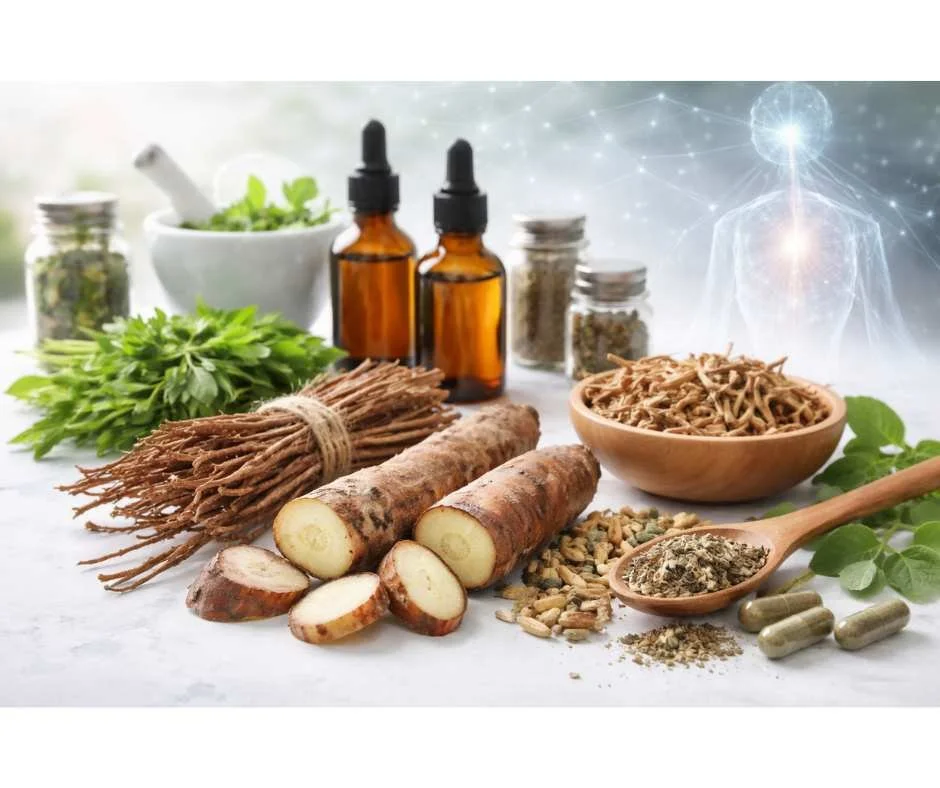
Lyme disease, caused primarily by Borrelia burgdorferi and transmitted through infected tick bites, can progress beyond an acute infection into a complex, multi-system condition. While short-term antibiotics are often effective early, a significant number of patients continue to experience persistent symptoms after treatment — including chronic fatigue, joint and muscle pain, cognitive impairment, insomnia, neuropathy, and autonomic instability. (1)
These ongoing symptoms are commonly described as Post-Treatment Lyme Disease Syndrome (PTLDS) or chronic Lyme disease. Emerging research suggests that persistent inflammation, immune dysregulation, biofilm-protected bacterial forms, persister cells, endothelial dysfunction, and mitochondrial impairment may all contribute to continued symptom burden — even when standard laboratory markers appear normal. (2)
In chronic Lyme disease, the problem is often not ongoing acute infection alone, but a disrupted internal terrain characterized by persistent inflammatory signaling, toxin accumulation, oxidative stress, endothelial dysfunction, and impaired mitochondrial energy production. Addressing chronic Lyme symptoms therefore requires more than repeated antimicrobial therapy; it requires immune recalibration, detoxification support, mitochondrial restoration, and structural tissue repair within a systems-based framework.
One of the most widely recognized herbal strategies for addressing chronic Lyme disease and associated co-infections is the Buhner Protocol, developed by herbalist and researcher Stephen Harrod Buhner. (3)
This article is about how the Buhner Protocol works, the core herbs involved, how it addresses chronic Lyme and common co-infections, and how it can be integrated into a functional medicine framework focused on long-term recovery.
What Is the Buhner Protocol for Lyme Disease?
The Buhner Protocol is a plant-based, multi-phase herbal treatment strategy developed to address chronic Lyme disease and common tick-borne co-infections. Rather than relying solely on antimicrobial eradication, the protocol focuses on reducing microbial virulence while restoring immune regulation and tissue integrity.
It is designed to:
Inhibit Borrelia burgdorferi and associated co-infections such as Babesia and Bartonella
Disrupt biofilm-protected and persister bacterial forms
Modulate inflammatory cytokine signaling
Protect collagen, endothelial, and nerve tissue from inflammatory damage
Support detoxification pathways and mitochondrial energy production
Unlike short-term antibiotic therapy, the Buhner approach uses targeted botanicals with antimicrobial, immune-modulating, and anti-inflammatory properties that can be titrated and used over extended periods. (4) This allows gradual microbial pressure while prioritizing host resilience, immune recalibration, and long-term restoration of physiological balance.
Core Herbs in the Buhner Protocol for Chronic Lyme Disease
The core herbal components of the Buhner Protocol are selected for their antimicrobial activity against Borrelia burgdorferi, their ability to disrupt biofilm-protected and persister forms, and their role in modulating inflammatory and immune responses associated with chronic Lyme disease. (5)
Each botanical serves a distinct pharmacologic function within the protocol.
Japanese Knotweed (Polygonum cuspidatum)
Rich in resveratrol
Antimicrobial and anti-inflammatory
Reduces microglial activation and neuroinflammation
Crosses the blood-brain barrier
Downregulates NF-κB inflammatory signaling
Japanese Knotweed is considered foundational for chronic Lyme symptoms involving cognitive dysfunction, headaches, and neurological inflammation.
Cat’s Claw (Uncaria tomentosa)
Immune modulator and antimicrobial
Enhances immune surveillance
Reduces cytokine overactivation
Supports collagen and connective tissue integrity
Cat’s Claw is frequently used to regulate immune dysregulation without overstimulating inflammatory pathways.
Chinese Skullcap (Scutellaria baicalensis)
Antioxidant and anti-inflammatory
Protects nerve tissue
Inhibits NF-κB inflammatory pathways
Supports vascular and endothelial stability
Skullcap is particularly useful in neuroinflammatory and vascular presentations of chronic Lyme disease.
Andrographis (Andrographis paniculata)
Broad-spectrum antimicrobial
Active against spirochetes and co-infections
Supports immune activity
May improve energy resilience
Andrographis is often introduced during antimicrobial escalation phases of the protocol.
Astragalus (Astragalus membranaceus)
Immune-enhancing adaptogen
Supports early immune response
Often used preventively
Typically not recommended in late-stage chronic Lyme
Astragalus is most appropriate in early infection or immune recovery phases rather than active late-stage inflammatory presentations.
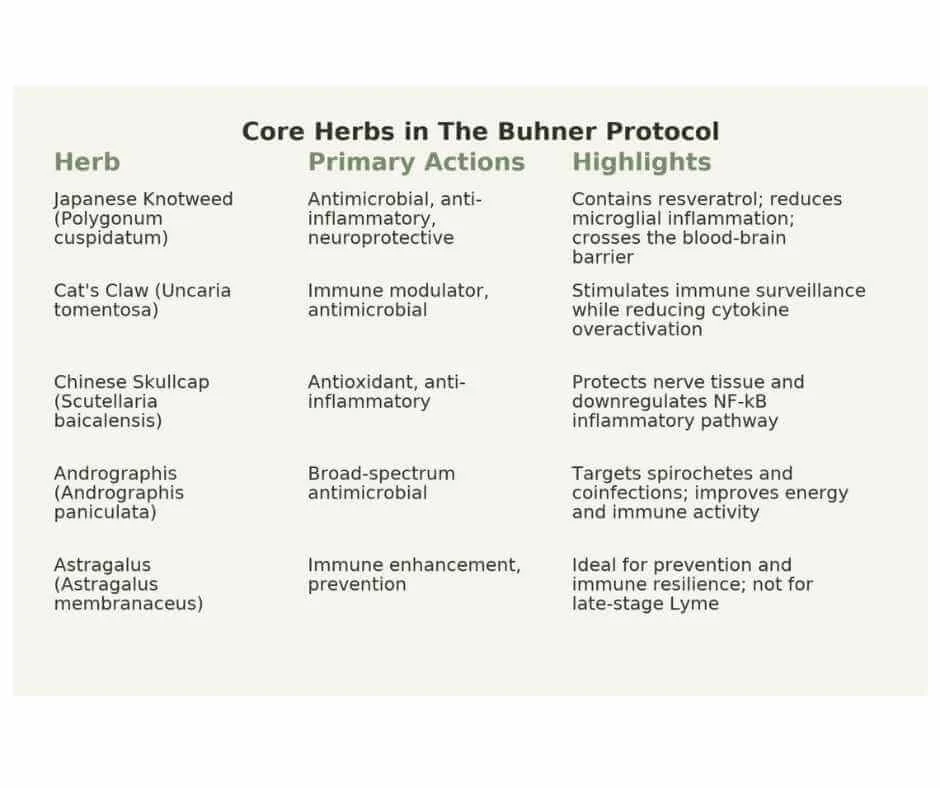
Together, these herbs work synergistically to weaken bacterial biofilms, reduce oxidative stress, modulate cytokine signaling, and support immune recalibration — addressing the persistent inflammatory terrain that characterizes chronic Lyme disease.
Herbal Support for Lyme Co-Infections
Chronic Lyme disease frequently involves additional tick-borne pathogens known as Lyme co-infections. Babesia, Bartonella, and other intracellular organisms can drive persistent inflammation, vascular dysfunction, neuropsychiatric symptoms, and treatment resistance. (6,7)
Co-infections often explain lingering symptoms such as air hunger, night sweats, anxiety, neuropathy, vascular pain, cognitive changes, and autonomic instability — even after antibiotic therapy has been completed.
Within the Buhner Protocol, specific botanicals are selected to target these organisms while modulating inflammatory and immune responses.
Cryptolepis sanguinolenta
Broad-spectrum antimicrobial activity
Active against Borrelia, Babesia, and Bartonella
May reduce parasitemia and intracellular persistence
Supports inflammatory regulation
Cryptolepis is commonly used when overlapping Lyme and Babesia patterns are present.
Artemisia annua (Sweet Wormwood)
Antiprotozoal activity
Particularly active against Babesia microti
Often used in cyclical protocols
May help reduce hemolytic and inflammatory burden
Artemisia is most often introduced when symptoms suggest active Babesia involvement.
Houttuynia cordata
Commonly used for Bartonella henselae
Supports vascular and endothelial integrity
May reduce neuroinflammation
Often helpful in neurological and psychiatric symptom clusters
Bartonella presentations frequently involve vascular irritation, neuropathy, anxiety, and cognitive dysfunction.
Isatis tinctoria
Antiviral and anti-inflammatory properties
Supports immune regulation
May be used when viral co-factors or immune suppression are suspected
Effective Lyme co-infection treatment requires individualized dosing, careful titration, and ongoing detoxification support to prevent inflammatory overload. Within a functional medicine framework, these botanicals are integrated alongside immune regulation, mitochondrial support, and toxin clearance strategies.
The Four Phases of the Buhner Protocol for Chronic Lyme Disease
Effective chronic Lyme treatment requires a structured, phased approach to reduce inflammatory burden, minimize Herxheimer reactions, and support immune and mitochondrial resilience. Within a functional medicine framework, the Buhner Protocol is often implemented in four progressive phases.
Phase 1: Detoxification and Terrain Preparation (Weeks 1–4)
Before initiating aggressive antimicrobial therapy, the body’s detoxification and regulatory systems are stabilized. This reduces the risk of inflammatory flares and die-off reactions.
Core strategies include:
Milk Thistle for hepatic protection and glutathione support
Red Root to enhance lymphatic drainage
Mitochondrial support: CoQ10, Acetyl-L-Carnitine, and PQQ to improve cellular ATP production
Binders to assist toxin clearance and reduce circulating inflammatory byproducts
Nervous system regulation through acupuncture, breathwork, circadian repair, and sleep optimization
This phase prepares the terrain before increasing antimicrobial pressure.
Phase 2: Core Herbal Antimicrobial Therapy (Months 1–6+)
Once detox pathways are supported, foundational herbs targeting Borrelia burgdorferi are introduced:
Japanese Knotweed
Cat’s Claw
Chinese Skullcap
Andrographis
Dosing is titrated gradually to minimize cytokine surges and Herxheimer reactions. Foundational detoxification and mitochondrial support continue throughout this phase, with monitoring of symptom patterns, inflammatory markers, and overall resilience.
Phase 3: Targeted Lyme Co-Infection Treatment (Months 3–12)
If Babesia, Bartonella, or other co-infections are present, additional botanicals are layered in:
Cryptolepis and Artemisia annua for Babesia
Houttuynia and Isatis for Bartonella
Herbs may be cycled to reduce microbial adaptation while maintaining liver, gut, and endothelial support to prevent inflammatory overload.
Phase 4: Maintenance and Long-Term Restoration
After symptom stabilization, antimicrobial intensity is gradually reduced while continuing immune and mitochondrial support.
Focus shifts toward:
Gut microbiome repair
Endothelial and collagen restoration
Hormone balance and HPA axis regulation
Stress resilience and autonomic stability
Ongoing toxin reduction strategies
This final phase emphasizes long-term immune recalibration rather than indefinite antimicrobial escalation.
Scientific Evidence and Clinical Limitations of the Buhner Protocol
Preclinical and mechanistic studies have demonstrated that several herbs used in the Buhner Protocol for chronic Lyme disease — including Japanese Knotweed, Cat’s Claw, Chinese Skullcap, Cryptolepis, Artemisia, and Thyme — exhibit in-vitro antimicrobial activity against Borrelia burgdorferi, including stationary-phase and persister forms. Laboratory research has also shown that certain botanical extracts may reduce biofilm formation and modulate inflammatory cytokine signaling associated with persistent infection.
However, large-scale randomized human trials evaluating the Buhner Protocol as a standardized Lyme disease treatment remain limited. In-vitro antimicrobial activity does not automatically translate into clinical cure, and outcomes depend heavily on individualized dosing, immune status, detoxification capacity, and overall physiological resilience.
In chronic Lyme disease — where immune dysregulation, neuroinflammation, endothelial dysfunction, and mitochondrial stress frequently persist — the strength of this protocol lies less in a single antimicrobial effect and more in its integrated, multisystem support. Rather than functioning solely as a “kill strategy,” the protocol emphasizes immune modulation, inflammatory regulation, tissue protection, and restoration of cellular energy production within a broader functional medicine framework.
Integrating the Buhner Protocol into a Functional Medicine Strategy for Chronic Lyme Disease
The Buhner Protocol aligns conceptually with a functional medicine model for chronic Lyme disease. Rather than focusing solely on antimicrobial eradication, both approaches emphasize immune modulation, inflammatory regulation, mitochondrial support, and detoxification capacity.
Chronic Lyme disease often reflects overlapping contributors, including:
Mycotoxin and heavy metal burden
Neuroendocrine dysregulation (adrenal and thyroid stress)
Mitochondrial dysfunction
Gut barrier disruption and microbiome imbalance
Autonomic nervous system instability
Within a systems-based framework, botanical antimicrobial strategies may be considered alongside:
Detoxification pathway support
Mitochondrial nutrient optimization
Gut repair strategies
Targeted nutrient repletion (magnesium, zinc, B-complex vitamins, omega-3s)
Lifestyle interventions including circadian regulation, toxin reduction, stress modulation, and restorative movement
This broader strategy prioritizes restoring physiological regulation rather than escalating antimicrobial intensity alone.
→ Detoxification & Environmental Medicine
Safety Considerations and Clinical Oversight
Botanical medicine is pharmacologically active and requires individualized dosing and professional supervision.
Potential considerations include:
Herb-drug interactions (including anticoagulants, antihypertensives, and hypoglycemics)
Allergic or hypersensitivity reactions
Pregnancy and breastfeeding precautions
Herxheimer reactions resulting from inflammatory die-off and toxin mobilization
Gradual titration, detox support, and close monitoring help minimize adverse reactions while improving tolerability in chronic Lyme treatment.
Functional Medicine Care for Chronic Lyme
Chronic Lyme disease and post-treatment Lyme symptoms reflect persistent immune activation, neuroinflammation, mitochondrial stress, and cumulative toxic burden.
Care at Denver Sports & Holistic Medicine focuses on:
Immune modulation
Detoxification pathway support
Mitochondrial restoration
Endothelial and connective tissue repair
Personalized botanical and nutraceutical therapy
Rather than escalating treatment pressure, this model emphasizes restoring regulatory capacity so the body can adapt, recalibrate, and recover more effectively over time.
→ Functional & Integrative Medicine
You may request a free 15-minute consultation with Dr. Martina Sturm to review your health concerns and outline appropriate next steps within a root-cause, systems-based framework.
Frequently Asked Questions About the Buhner Protocol for Chronic Lyme Disease
Does the Buhner Protocol work for chronic Lyme disease?
The Buhner Protocol is commonly used in chronic Lyme disease and post-treatment Lyme presentations where immune dysregulation, inflammation, and mitochondrial stress persist after antibiotics. Its strength lies in combining antimicrobial botanicals with immune modulation and tissue protection rather than relying on bacterial eradication alone.
How long does the Buhner Protocol take to work?
Most protocols are implemented over 6 to 12 months or longer, depending on symptom severity, detoxification capacity, and the presence of co-infections. Herbs are introduced gradually to minimize inflammatory flare reactions and improve tolerability.
Can the Buhner Protocol replace antibiotics?
Acute Lyme disease is typically treated with antibiotics. The Buhner Protocol is most often considered in chronic or persistent cases where symptoms continue despite prior treatment, focusing on immune regulation and inflammatory control.
What herbs are used in the Buhner Protocol for Lyme disease?
Core herbs commonly include Japanese Knotweed, Cat’s Claw, Chinese Skullcap, and Andrographis. When co-infections such as Babesia or Bartonella are present, additional botanicals like Cryptolepis, Artemisia annua, Houttuynia, or Isatis may be incorporated based on symptom patterns and clinical findings.
Can the Buhner Protocol help treat Babesia or Bartonella?
Yes. Specific herbs within the protocol are selected to address common Lyme co-infections. Artemisia and Cryptolepis are often used in Babesia patterns, while Houttuynia and related botanicals may be considered in Bartonella presentations.
What are Herxheimer reactions during the Buhner Protocol?
A Herxheimer reaction is a temporary worsening of symptoms caused by inflammatory responses to microbial die-off and toxin mobilization. Symptoms may include fatigue, headaches, body aches, brain fog, or flu-like discomfort. Gradual dosing and detoxification support help reduce severity.
Is the Buhner Protocol safe?
Botanical medicine is pharmacologically active and must be individualized. Certain herbs may interact with medications or affect blood pressure, blood sugar, or pregnancy status. Proper dosing and clinical supervision improve safety and tolerability.
What dosage is used in the Buhner Protocol?
Dosage varies based on body weight, symptom severity, detoxification capacity, and individual sensitivity. Most herbs are introduced at low doses and titrated upward over several weeks to reduce inflammatory reactions.
Does the Buhner Protocol cure Lyme disease?
There is no universally recognized cure for chronic Lyme disease. The Buhner Protocol is designed to reduce microbial burden, regulate immune dysfunction, and support tissue repair. Outcomes vary depending on inflammatory load, toxic burden, and overall resilience.
Still Have Questions?
If the topics above reflect ongoing symptoms or unanswered concerns, a brief conversation can help clarify whether a root-cause approach is appropriate.
Resources
Clinical Microbiology and Infection – Efficacy and safety of antibiotic therapy for post-Lyme disease? A systematic review and network meta-analysis
Frontiers in Medicine – Post-treatment Lyme Disease as a Model for Persistent Symptoms in Lyme Disease
Stephen Harrod Buhner – Herbal Antivirals: Natural Remedies for Emerging & Resistant Viral Infections
Antibiotics (Basel) – A Comprehensive Review of Herbal Supplements Used for Persistent Symptoms Attributed to Lyme Disease
Frontiers in Medicine – Persistent symptoms after treatment for Lyme disease: “Confusion worse confounded.” John Milton, Paradise Lost. Book II
Nutrients – The Use of Natural Bioactive Nutraceuticals in the Management of Tick-Borne Illnesses