

Food Quality vs Calories: What Actually Drives Weight Loss and Hormone Balance
Why Hormones, Hunger Signals, and Metabolic Function Matter More Than Calories for Weight Loss
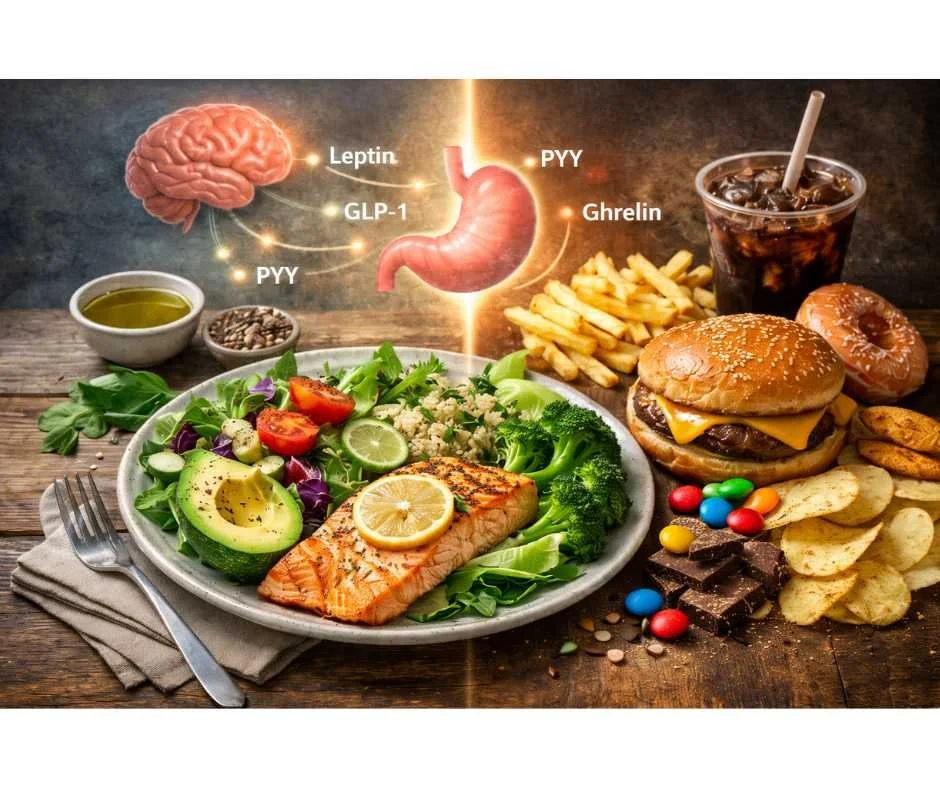
For decades, weight loss has been reduced to calorie counting: eat less, move more, and track the numbers. But food quality—not math—determines how hunger hormones, fat storage, and metabolic function are regulated.
When meals are built around ultra-processed foods, appetite signaling becomes disrupted, energy fluctuates, and weight loss becomes increasingly difficult to sustain. In contrast, nutrient-dense whole foods send precise biological signals that influence leptin, insulin, GLP-1, ghrelin, and other hormones that control appetite, satiety, and fuel use.
When these systems function properly, calorie intake naturally stabilizes. When they are impaired, no amount of restriction produces lasting results.
The problem isn’t discipline—it’s physiology. And the model most people have been taught is incomplete.
Does Food Quality Matter More Than Calories for Weight Loss?
Food quality matters more than calories because it regulates hunger hormones, blood sugar, inflammation, and metabolic function. Calories measure energy intake, but metabolic signaling determines appetite, fat storage, and energy use. When these systems are disrupted, no amount of calorie restriction produces sustainable results. This reflects current understanding in metabolic physiology, where energy balance is governed by integrated hormonal, neurological, and cellular signaling systems rather than calorie intake alone.
The human body is not governed by calorie math alone. It is regulated by a complex network of hormones, gut–brain signaling, nutrient sensing, and metabolic feedback loops that determine how hungry you feel, how efficiently you burn fuel, and whether energy is stored or used.
Food quality plays a decisive role in this process. Nutrient-dense foods actively communicate with hunger and satiety hormones—including leptin, insulin, GLP-1, PYY, and ghrelin—helping coordinate appetite and energy balance. Ultra-processed foods, in contrast, distort these signals, driving cravings, overeating, and metabolic dysfunction.
Why Calorie Counting Fails for Long-Term Weight Loss and Metabolic Health
For decades, weight loss has been framed as a simple equation: calories in versus calories out. While this model appears logical, it does not reflect how the body actually regulates hunger, energy expenditure, and fat storage.
Calories measure heat energy—not biological impact. Two foods with identical calorie values can produce vastly different hormonal, metabolic, and inflammatory responses in the body (1). These responses directly influence appetite, blood sugar control, fat storage, and long-term metabolic health.
This does not mean calories are irrelevant. It means calorie intake is regulated by underlying physiological systems—including hormones, metabolic function, and nutrient signaling—rather than controlled directly through restriction alone.
Why “Calories In vs Calories Out” Doesn’t Reflect How Metabolism Works
Highly processed foods—especially those rich in refined carbohydrates, industrial seed oils, and artificial additives—disrupt metabolic signaling by:
Driving rapid blood sugar spikes and crashes
Increasing oxidative stress and systemic inflammation
Impairing appetite-regulating hormone signaling
Over time, these disruptions impair the body’s ability to regulate hunger and energy balance effectively (2).
How Whole Foods Improve Hormonal and Metabolic Signaling
In contrast, whole, nutrient-dense foods provide essential biological inputs that support communication across the gut, brain, liver, and adipose tissue.
These foods supply:
Complete amino acids for hormone and neurotransmitter production
Essential fatty acids for cellular signaling
Vitamins, minerals, and phytonutrients that support enzymatic and mitochondrial function
These inputs influence whether energy is:
Burned for immediate use
Stored as fat
Directed toward repair and metabolic maintenance (3)
Why Calorie Restriction Slows Metabolism and Increases Hunger
When calories are reduced without adequate nutrient density or hormonal support, the body responds defensively. This often leads to:
Increased hunger and food preoccupation
Reduced resting metabolic rate
Greater efficiency at storing fat once intake increases
This adaptive response explains why calorie restriction alone frequently results in stalled progress and weight regain rather than sustained metabolic improvement (4).
From a physiological standpoint, sustainable weight regulation depends less on how much you eat and more on the metabolic signals your food provides, reflecting how energy balance is governed by integrated hormonal and cellular systems.
→ Weight Loss & Metabolic Health
How Whole Foods Regulate Hunger Hormones and Support Appetite Control
Your appetite is not governed by willpower. It is regulated by a coordinated network of hormones that communicate between the gut, brain, pancreas, and adipose tissue. These signals determine hunger, fullness, and how long satiety is maintained.
Whole, minimally processed foods support this signaling network. Ultra-processed foods disrupt it.
Leptin and Weight Gain: How Leptin Resistance Increases Hunger
Leptin is produced by adipose tissue and acts as a long-term signal of energy availability to the brain. When leptin signaling is intact, the brain recognizes adequate energy stores and reduces appetite accordingly.
Chronic intake of highly processed foods—particularly those high in sugar and industrial seed oils—promotes leptin resistance, a state in which leptin is present but its signal is not properly received. This results in persistent hunger despite sufficient or excess energy intake (5).
Whole-food support for leptin signaling includes:
Adequate protein intake
Anti-inflammatory fats
Antioxidant-rich vegetables and fruits
These inputs help restore leptin sensitivity and improve appetite regulation (6).
GLP-1 and Appetite Control: How Fiber Increases Natural GLP-1 Levels
GLP-1 is released from the intestine in response to food intake. It slows gastric emptying, supports insulin sensitivity, and signals fullness to the brain. While medications mimic this pathway, the body naturally produces GLP-1 in response to specific dietary inputs.
Fiber-rich whole foods stimulate endogenous GLP-1 release, whereas refined carbohydrates and artificial sweeteners impair this response (7).
Foods that support GLP-1 signaling include:
Non-starchy vegetables
Legumes
Resistant starches
Whole, unprocessed plant fibers
When GLP-1 signaling is supported, appetite decreases and blood sugar regulation improves (8).
PYY and Satiety: How Protein and Fiber Reduce Cravings and Increase Fullness
Peptide YY (PYY) is released shortly after eating, particularly in response to protein and fiber. It communicates with appetite centers in the brain to promote satiety and reduce subsequent food intake.
Diets dominated by refined carbohydrates and processed foods blunt PYY release, making it easier to overeat despite adequate caloric intake (9).
Balanced meals that include protein, fiber, and healthy fats increase PYY levels and support sustained satiety (10).
Ghrelin and Hunger: How Blood Sugar Instability Increases Cravings
Ghrelin stimulates appetite and typically rises before meals. While this is a normal physiological signal, frequent blood sugar fluctuations caused by refined carbohydrates exaggerate ghrelin spikes and drive cravings.
Protein-rich, nutrient-dense meals help suppress excessive ghrelin release and promote more stable hunger patterns (11).
Insulin and Fat Storage: How Refined Carbohydrates Increase Fat Storage and Disrupt Metabolism
Insulin regulates whether energy is stored or used. Repeated insulin spikes—driven by refined carbohydrates and frequent eating—promote fat storage and impair metabolic flexibility.
Whole foods that digest more slowly help stabilize insulin signaling, allowing the body to shift more efficiently between glucose and fat as fuel (12).
How Hunger Hormones Work Together to Regulate Appetite and Weight
When hunger hormones are supported through food quality:
Appetite becomes more predictable
Satiety increases without conscious restriction
Energy levels stabilize
Calorie intake naturally self-regulates
This is why nutrition that supports coordinated hormonal signaling consistently outperforms calorie counting for long-term metabolic health.
Food Quality vs Calories: What Matters More for Weight Loss and Metabolism?
Food quality and calorie counting influence weight loss through different biological mechanisms. Calories measure energy quantity, while food quality determines how hunger hormones, blood sugar, inflammation, and metabolic function are regulated. Sustainable weight loss depends on coordinated hormonal and metabolic signaling—not calorie math alone.
How Food Quality Regulates Hormones, Metabolism, and Appetite
Food quality directly affects:
Hunger hormone regulation (leptin, ghrelin, GLP-1, PYY)
Blood sugar stability and insulin response
Inflammatory signaling that influences fat storage
Metabolic flexibility and mitochondrial function
Long-term appetite control and satiety
How Calorie Counting Affects Energy Intake but Not Metabolic Signaling
Calorie counting primarily affects:
Total energy intake
Short-term weight fluctuations
Behavioral tracking and food monitoring
Temporary calorie deficits without correcting underlying hormonal and metabolic signaling
Why Processed and “Diet” Foods Disrupt Hunger Hormones and Metabolism
Many foods marketed as “low-calorie,” “diet,” or “weight-loss friendly” are engineered to reduce calorie intake without supporting the hormonal and metabolic systems that regulate hunger, energy balance, and fat storage.
Do Artificial Sweeteners Increase Hunger and Cravings?
Artificial sweeteners activate sweet taste receptors without providing corresponding nutrients. This mismatch disrupts gut–brain signaling and can impair insulin and GLP-1 responses, increasing appetite rather than suppressing it (13).
Over time, this disconnect can:
Increase cravings for sweet foods
Disrupt blood sugar regulation
Reduce satiety after meals
How Industrial Seed Oils Promote Inflammation and Weight Gain
Highly refined seed oils are rich in omega-6 fatty acids that are prone to oxidation during processing and cooking. Excess intake promotes low-grade inflammation, which interferes with leptin and insulin signaling (14).
When inflammatory signaling increases:
Leptin resistance worsens
Insulin sensitivity declines
Fat storage becomes metabolically favored
How Refined Carbohydrates Disrupt Blood Sugar and Increase Hunger
Refined grains are rapidly digested and absorbed, leading to sharp rises in blood glucose followed by insulin spikes and crashes. These fluctuations amplify hunger hormones and drive repeated eating episodes (15).
This pattern:
Triggers ghrelin surges
Suppresses PYY release
Reinforces cravings rather than satiety
How Ultra-Processed Foods Disrupt Gut–Brain Signaling and Appetite Control
Ultra-processed foods are stripped of fiber, micronutrients, and structural complexity. Without these inputs, the gut cannot generate appropriate satiety signals, even when calorie intake is high (16).
As a result, the brain receives delayed or incomplete information about energy intake, making it difficult to recognize fullness or regulate intake accurately.
Why Eating Less Doesn’t Fix Hormone-Driven Weight Gain
When the diet is dominated by processed foods, reducing calories further often worsens the problem. The body interprets the combination of low nutrition and unstable signaling as a stressor, leading to:
Increased hunger
Reduced metabolic rate
Heightened fat-storage efficiency
This explains why many people feel constantly hungry and fatigued while following calorie-restricted diets based on processed foods (17).
Processed foods do not simply add excess calories—they distort hormonal signaling that governs appetite, energy balance, and fat metabolism. In this environment, calorie counting treats the symptom rather than the cause.
Restoring food quality is therefore a prerequisite for restoring metabolic regulation.
→ Detoxification & Environmental Medicine
How Food Quality Supports Natural Weight Loss and Metabolic Function Without Calorie Counting
When food quality is high and hormonal signaling is intact, the body does not need to be forced into weight loss. Appetite, energy use, and fat storage begin to self-regulate.
This occurs because nutrient-dense whole foods provide the biological inputs required for stable metabolic communication across the gut, brain, liver, muscle, and adipose tissue.
What Happens When Hunger Hormones Function Properly
When meals consistently include adequate protein, fiber, micronutrients, and healthy fats:
Satiety hormones rise appropriately after eating
Hunger signals diminish between meals
Blood sugar remains more stable
Energy levels improve without reliance on stimulants
As a result, total calorie intake often decreases without intentional restriction (18).
Why Two Diets With the Same Calories Produce Different Weight Loss Outcomes
Calories alone do not determine metabolic outcomes. Hormonal and inflammatory responses to food influence whether energy is:
Used immediately for cellular activity
Stored as fat
Directed toward repair and metabolic maintenance
Whole, nutrient-dense foods support efficient fuel use and metabolic flexibility, while processed foods favor energy storage and repeated hunger (19).
This explains why similar calorie intake can lead to very different body composition and energy outcomes depending on food quality (20).
How Mitochondrial Function Influences Fat Burning and Metabolic Efficiency
Mitochondria require adequate nutrients to convert food into usable energy. Diets rich in vitamins, minerals, and phytonutrients support mitochondrial function and reduce oxidative stress.
When mitochondrial function is supported:
Fat oxidation increases
Energy production becomes more efficient
Metabolic resilience improves (21)
These processes cannot be replicated through calorie restriction alone.
Why Weight Loss Is a Biological Process, Not a Willpower Issue
When hunger hormones, insulin signaling, and cellular energy systems are supported, the body naturally moves toward a healthier weight range.
This is not a matter of discipline. It reflects the restoration of physiological regulation through food quality.
Sustainable weight regulation occurs when the body receives consistent metabolic signals—not when it is forced into chronic restriction. Nutrient-dense foods allow appetite, metabolism, and energy regulation to function in coordination rather than conflict.
A Functional Medicine Approach to Weight Loss and Metabolic Health
From a functional medicine perspective, weight challenges are rarely isolated. They reflect disruptions across interconnected systems, including hormone signaling, blood sugar regulation, gut health, nutrient status, inflammation, and stress physiology.
Rather than focusing on calorie intake alone, this approach examines why the body is struggling to regulate appetite, energy use, and fat storage.
Why Weight Gain Reflects Metabolic Dysfunction
Persistent hunger, cravings, fatigue, and weight resistance often indicate underlying dysfunction, including:
Impaired insulin sensitivity
Leptin resistance
Chronic low-grade inflammation
Gut microbiome imbalance
Nutrient deficiencies affecting cellular energy production
When these factors are present, the body adapts by conserving energy and increasing appetite—regardless of calorie intake (22).
Why Standard Diets Fail for Hormone-Driven Weight Gain
Conventional dietary models assume metabolic responses are uniform. In reality, responses vary based on physiology, environment, toxin exposure, stress load, sleep quality, and prior dietary patterns.
The same diet can produce very different outcomes depending on internal metabolic context. Hormonal signaling—not dietary rules alone—determines how food is processed and utilized (23).
What Functional Medicine Evaluates in Metabolic Weight Gain
A functional approach focuses on identifying and correcting disruptions in metabolic signaling. Evaluation may include:
Blood sugar regulation and insulin dynamics
Inflammatory and oxidative stress markers
Micronutrient status related to hormone and mitochondrial function
Digestive function and gut microbiome balance
Stress physiology and nervous system regulation
Addressing these areas allows improvements in food quality to translate into meaningful metabolic change (24).
How to Restore Metabolic Flexibility for Sustainable Fat Loss
The goal is not chronic restriction, but metabolic flexibility—the ability to shift efficiently between glucose and fat as fuel.
When metabolic flexibility is restored:
Hunger becomes more predictable
Energy levels stabilize
Fat loss occurs without persistent deprivation
Weight becomes easier to maintain over time (25)
This state cannot be achieved through calorie restriction alone. It requires restoring the biological systems that regulate energy use and storage.
Why a Systems-Based Approach Improves Weight Loss Outcomes
Weight regulation is a physiological process, not a matter of willpower. When hormonal signaling, metabolic function, and cellular energy systems are supported, the body can regulate appetite, energy, and fat storage more effectively.
Functional medicine reframes weight concerns as a systems-based issue rather than a personal failure. By identifying and correcting the root causes of metabolic dysfunction, the body regains its capacity to self-regulate.
→ Functional & Integrative Medicine
How Food Quality Improves Metabolic Function and Supports Weight Loss Without Dieting
Improving food quality does not require rigid rules, tracking apps, or extreme restriction. Excessive control often increases stress signaling, which can further disrupt appetite regulation and metabolic function.
The goal is to support consistent metabolic signaling—not to micromanage intake.
How Food Quality Supports Hunger Hormones and Metabolism
Rather than focusing on what to eliminate, prioritize foods that support hunger hormones, blood sugar stability, and cellular energy production.
Key principles include:
Building meals around whole, minimally processed foods
Including protein at each meal to support satiety
Pairing carbohydrates with fiber and healthy fats to slow absorption
Eating enough to avoid chronic under-fueling
This approach reduces reliance on ultra-processed foods without triggering deprivation responses (26).
Why Ingredient Quality Matters More Than Macronutrients
Macronutrient ratios matter less than ingredient quality. Meals built from real, nutrient-dense foods naturally regulate appetite regardless of precise carbohydrate or fat percentages.
High-quality choices include:
Organic vegetables and fruits
Pasture-raised eggs and meats
Wild-caught fish
Traditional fats such as olive oil, avocado oil, butter, and ghee
These foods provide the micronutrients and fatty acids required for hormone signaling and metabolic resilience (27).
How Reducing Inflammatory Foods Improves Hormones and Metabolism
Many hunger signals are amplified by dietary stressors rather than true energy needs.
Reducing exposure to:
Industrial seed oils
Artificial sweeteners
Refined flours and sugars
helps stabilize insulin signaling and reduce inflammation, allowing appetite regulation to normalize over time (28).
How Gut–Brain Signaling Regulates Appetite and Satiety
Gut health plays a central role in appetite regulation and nutrient absorption.
Supportive habits include:
Eating fiber-rich vegetables regularly
Including fermented foods as tolerated
Chewing thoroughly and eating without distraction
Allowing time between meals for hormonal reset
Consistent gut support improves satiety signaling and metabolic communication (29).
How Stress and Sleep Disrupt Hunger Hormones and Metabolism
Chronic stress and inadequate sleep elevate hunger signaling independent of calorie needs.
Supporting nervous system regulation through sleep, hydration, and stress management improves the body’s ability to interpret hunger cues accurately and maintain metabolic stability (30).
Why Hormonal Regulation Matters More Than Calories for Weight Loss
When weight loss is approached as a matter of calorie restriction, the body often responds with increased hunger, reduced energy, and metabolic resistance.
When nutrition is understood as hormonal signaling, the process changes. Nutrient-dense foods provide the inputs required to regulate appetite, stabilize blood sugar, and support efficient energy use.
When these signals are consistent, the body begins to self-regulate—reducing the need for control, restriction, or constant monitoring.
Sustainable weight balance is achieved by restoring the biological systems that govern hunger, satiety, and metabolic flexibility—not by enforcing stricter dietary rules.
When Weight Loss Resistance Signals Metabolic Dysfunction
If progress stalls despite consistent effort, this often reflects disrupted metabolic signaling rather than lack of discipline.
Weight resistance may be associated with:
Hormonal imbalances affecting appetite and energy regulation
Blood sugar instability and insulin resistance
Inflammatory or nutrient-related barriers to fat metabolism
Gut-related disruptions affecting satiety signaling
Addressing these factors allows food quality improvements to translate into meaningful metabolic change.
When metabolic signaling is restored, weight regulation becomes more predictable, and the body can respond appropriately to nourishment.
If food quality has not translated into results, signaling—not discipline—may be the limiting factor.
If weight loss remains resistant despite consistent effort, a deeper evaluation of metabolic signaling may be necessary.
You may request a free 15-minute consultation with Dr. Martina Sturm to review your health concerns and outline appropriate next steps within a root-cause, systems-based framework.
Food Quality vs Calories: Frequently Asked Questions About Hormones and Weight Loss
Is calorie counting necessary for weight loss?
No. Calorie counting is not required when hunger hormones and metabolic signaling are functioning properly. Food quality influences leptin, insulin, GLP-1, ghrelin, and PYY, which regulate appetite and fat storage. When these systems are stable, calorie intake often decreases naturally without tracking or restriction.
Why does calorie restriction slow metabolism?
Calorie restriction can reduce resting metabolic rate by increasing hunger signaling and lowering energy output. When the body perceives sustained energy scarcity, it adapts by conserving fuel, increasing appetite, and becoming more efficient at storing fat when intake rises.
How do hormones affect weight loss?
Hormones regulate appetite, energy use, and fat storage. Leptin signals fullness, ghrelin stimulates hunger, GLP-1 and PYY promote satiety, and insulin controls fuel storage. When these signals are disrupted, appetite becomes less predictable and weight regulation becomes more difficult.
Does food quality matter more than calories for weight loss?
Yes. Food quality influences hormonal and metabolic signaling, blood sugar stability, inflammation, and metabolic flexibility. Calories measure energy quantity but do not determine how the body regulates appetite or fat storage. Nutrient-dense foods support weight regulation in ways calorie tracking alone cannot.
Why do processed foods make weight loss harder?
Ultra-processed foods disrupt gut–brain signaling, destabilize blood sugar, and promote inflammation that impairs leptin and insulin function. These effects increase hunger and reduce satiety, making it harder to maintain a stable calorie intake even when food quantity appears controlled.
Can you lose weight without counting calories?
Yes. Many people lose weight by improving food quality alone. Meals rich in protein, fiber, and healthy fats support hormonal signaling, making appetite more predictable and reducing overeating without the need for tracking.
What is metabolic flexibility and why does it matter for fat loss?
Metabolic flexibility is the ability to switch between burning glucose and fat for fuel. When insulin signaling and mitochondrial function are supported, the body uses energy more efficiently. Impaired metabolic flexibility promotes fat storage and unstable energy levels.
Why does weight loss become harder over time?
Repeated dieting, chronic stress, poor sleep, inflammation, and blood sugar instability can disrupt hormonal signaling and reduce metabolic efficiency. Over time, these adaptations make calorie restriction less effective and increase the likelihood of weight regain.
Still Have Questions?
If the topics above reflect ongoing symptoms or unanswered concerns, a brief conversation can help clarify whether a root-cause approach is appropriate.
Resources
Cell Metabolism – Calorie restriction, energy balance, and metabolic adaptation
Nature Reviews Endocrinology – Leptin resistance and metabolic disease
The American Journal of Clinical Nutrition – Diet composition and metabolic signaling
Obesity Reviews – Adaptive thermogenesis and weight regain
Endocrine Reviews – Central regulation of appetite and energy balance
Physiology & Behavior – Ghrelin and appetite regulation
Diabetes Care – Insulin signaling and metabolic flexibility
The Journal of Nutrition – Protein-induced satiety and appetite hormones
Gut – GLP-1 and gut–brain communication
The American Journal of Physiology – Gastrointestinal and Liver Physiology – Peptide YY and satiety
Nutrients – Dietary fiber and glycemic control
The Lancet Diabetes & Endocrinology – Ultra-processed foods and metabolic health
Current Opinion in Endocrinology, Diabetes and Obesity – Artificial sweeteners and appetite regulation
Progress in Lipid Research – Omega-6 fatty acids and inflammation
The Journal of Clinical Endocrinology & Metabolism – Hormonal regulation of body weight
Metabolism – Macronutrient signaling and body composition
Molecular Metabolism – Mitochondrial function and nutrient availability
Frontiers in Endocrinology – Inflammation and insulin resistance
The American Journal of Physiology – Endocrinology and Metabolism – Metabolic flexibility
Nutrients – Micronutrient status and energy metabolism
Cell Reports – Nutrient sensing pathways and energy regulation
Trends in Endocrinology & Metabolism – Systems biology of metabolic dysfunction
Psychoneuroendocrinology – Stress hormones and appetite regulation
The Journal of the Academy of Nutrition and Dietetics – Diet quality and weight outcomes
Nature Metabolism – Hormonal control of energy balance